Best Office Chairs for Tall People Under $300

Photo by Lasse Jensen on Unsplash
Best Office Chairs for Tall People Under $300
Tall people often get the short end of the stick when shopping for office chairs—most budget models max out at 5‘10” or so. The good news: you don’t need to spend premium money to find a chair that actually fits your frame. The key is knowing what specs matter: seat height range, backrest height, and lumbar curve depth. This guide walks you through the best sub- options built for users 6’ and up.
Why Standard Office Chairs Fail Tall Users
Most budget office chairs come with a fixed seat height or a narrow adjustment range. If you’re 6‘2” or taller, you’ll either sit with your knees higher than your hips (bad posture) or your feet dangling (no leg support). The backrest is equally problematic—it stops at mid-shoulder for average-height people, leaving your upper back unsupported.
A tall-friendly chair needs:
- Seat height minimum of 20 inches (and ideally up to 23–24 inches when fully raised)
- Backrest height of 26+ inches from the seat base
- Lumbar depth of 3+ inches to support your lower spine properly
- Weight capacity of 250+ pounds (taller people tend to be heavier)
Budget chairs that skip these specs will leave you hunched, strained, and in pain after four hours of work.
What Makes a Chair Work for Tall Frames
Seat Height and Depth
Your thighs should be parallel to the floor when you sit with feet flat. This means the seat height needs to clear your knee height by about 1–2 inches. For someone 6‘2”–6‘4”, that’s typically 20–22 inches. Cheap chairs often max out at 19 inches, forcing you to sit too low.
Seat depth also matters. A shallow seat (under 18 inches) will push your knees past the edge, cutting off circulation. Look for 19–21 inches of depth.
Backrest Length and Lumbar Support
A tall person’s lower back sits much lower relative to their overall torso. A short backrest that ends at mid-shoulder won’t support your lumbar spine where you need it most. You want at least 26 inches of backrest height, and ideally a curved lumbar section that actually protrudes (not just a thin cushion glued on).
Armrest Height
Armrests that are too low will force your shoulders up, causing neck and shoulder strain. When your arms rest on the armrests with elbows at 90 degrees, your shoulders should be relaxed. Most tall users need armrests at 20–22 inches high. Many budget chairs have fixed armrests at 18–19 inches—a deal-breaker.
Weight Capacity and Base Stability
Taller people typically weigh more. A 250-pound weight limit on a chair is risky if you’re in the 200–220 range; you’ll be at the edge of safe use. Look for 275+ pounds minimum. The base should be a five-point star (not four-point) and made of reinforced nylon or metal.
Top Picks for Tall Users Under $300
Our top pick: Furmax Tall Office Chair with High Back. This model is built specifically for tall frames. The seat height ranges from 20 to 24 inches, backrest height is 28 inches, and the lumbar curve is pronounced. Mesh back keeps you cool, and it supports users up to 300 pounds. The tilt mechanism is smooth, and the armrests are adjustable in height and width.
Runner-up: Hbada Ergonomic Office Chair. Hbada chairs punch above their weight for the price. The backrest is 27 inches tall, seat height goes up to 23 inches, and the mesh design is breathable. The lumbar support is firmer than the Furmax, which some tall users prefer. Weight capacity is 300 pounds.
Budget pick: 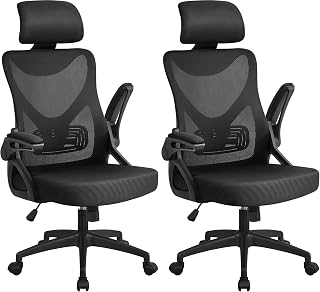
Alternative: KERDOM Ergonomic Office Chair. A mid-range option with excellent lumbar support and a taller backrest (27 inches). The seat adjusts from 18 to 22 inches, which is slightly lower than the Furmax but still workable for 6‘0”–6‘2” users. Breathable mesh, 300-pound capacity.
For extra comfort: SIDIZ T50 Mesh Office Chair. If you can stretch to the upper end of the budget, this Korean-made chair is worth it. Backrest is 29 inches, seat height up to 23 inches, and the lumbar support is genuinely ergonomic (not just decorative). Designed for all-day comfort, especially for taller frames.
Mesh vs. Fabric: What’s Best for Tall Users?
Mesh is the standard for budget tall chairs because it’s breathable and durable. It also looks less bulky, which matters if your chair is visible in video calls. The downside: mesh doesn’t cushion as much as fabric, so you feel the frame underneath if you shift around a lot.
Fabric (usually polyurethane or vinyl) offers more cushioning but traps heat and can get sticky in summer. For tall users who sit still most of the day, mesh is the better choice. If you’re fidgeting constantly or live in a hot climate, consider a hybrid (mesh back, fabric seat).
Lumbar Support: Don’t Settle for Fake
Many budget chairs have a lumbar “support” that’s just a thin pad glued to the back. For tall users, this is useless—your lumbar spine sits lower and needs actual depth and curve.
Real lumbar support has:
- Protrusion of 2–3 inches from the backrest surface
- Curve that matches your spine’s natural shape (not flat)
- Adjustability so you can raise or lower it to your exact lumbar position
The Furmax and Hbada both have genuine lumbar curves. The Yaheetech is flatter, so if lower back pain is your main issue, spend the extra and go with Furmax or Hbada.
Assembly and Warranty Considerations
Budget tall chairs often ship unassembled. Allow 30–45 minutes for setup. Most include basic tools, but having your own Phillips head screwdriver and hex wrench set speeds things up.
Warranty is usually 1 year on parts and labor. This is standard for the sub- category. If a chair fails within a year, you should be able to get a replacement or refund. Check the seller’s return policy before buying—Amazon’s 30-day return window is safer than direct-from-manufacturer sales.
How Tall Chairs Fit Into Your Full Setup
A tall chair is just one piece. If you’re setting up a home office from scratch, consider pairing it with:
- A desk at the right height (typically 28–30 inches) so your elbows are at 90 degrees when typing
- A monitor arm (Best Monitor Arms Under $100) to position your screen at eye level, reducing neck strain
- An anti-fatigue mat (Best Anti-Fatigue Mats for Home Office Under $100) if you plan to stand part of the day
- An ergonomic keyboard (Best Budget Ergonomic Keyboards Under $80) to keep your wrists neutral
A tall chair alone won’t fix poor posture if your desk is too low or your monitor is too high. See our guide on Budget Home Office Ergonomics Setup Under $500 for a complete setup breakdown.
Common Mistakes Tall Users Make When Buying
-
Ignoring seat depth. You focus on height but forget that a shallow seat cuts off your thighs. Always check the depth spec.
-
Assuming “high back” means tall. Many chairs claim “high back” but only have 24 inches of height. Read the actual measurement, not the marketing label.
-
Skipping the weight capacity. If you weigh 210 pounds and the chair maxes at 250, you’re operating at the edge of safety. Go 50+ pounds over your weight for comfort and durability.
-
Not testing the tilt tension. A chair that’s too easy to recline or too stiff will frustrate you daily. Most budget chairs let you adjust tilt tension—find the sweet spot.
-
Buying without measuring your current desk. If your desk is 28 inches high and your new chair only goes to 21 inches, your elbows will be too high. Measure first.
FAQ
Q: What’s the minimum seat height I need if I’m 6‘3”? A: Aim for at least 21 inches, ideally 22–23 inches. At 21 inches, your feet will be flat on the floor with knees at 90 degrees. Anything lower and your knees will creep up.
Q: Can I use a regular chair and just add a lumbar pillow? A: Not if the chair itself is too short. A lumbar pillow helps but won’t fix a backrest that ends at your mid-back. You need the full-height chair first, then add a pillow if needed.
Q: How long do budget tall chairs last? A: With proper use (adjusting height and tilt gently, not leaning back aggressively), 3–5 years is typical. Heavy daily use might shorten that to 2–3 years. Premium chairs last 7–10 years, but the jump in cost isn’t always worth it for home office use.
Q: Are armrests necessary for tall users? A: Yes. Without armrests, your shoulders will hunch up to support your arms, causing neck and shoulder pain. Adjustable armrests are ideal—fixed ones are better than none but less comfortable.
Q: What if I’m 6‘4” and nothing fits? A: You’re in the extreme range. Look for chairs with the absolute highest seat height (23+ inches) and longest backrest (28+ inches). You may need to consider premium brands or custom options, which will exceed the budget.
Final Thoughts
Finding an office chair that fits a tall frame on a budget requires knowing exactly what to look for: seat height of 20+ inches, backrest height of 26+ inches, and genuine lumbar support. The Furmax Tall Office Chair is the most reliable pick for most tall users. If you want to save a few dollars, the Yaheetech is serviceable. If you want maximum comfort and don’t mind spending closer to the SIDIZ T50 is worth the investment.
The mistake most tall people make is buying a “regular” chair and hoping it works. It won’t. Spend the time to verify measurements before checkout, and you’ll avoid months of back pain and the hassle of returning a chair that doesn’t fit.


