Best Affordable Standing Desk Converters Under $200

Photo by TheStandingDesk on Unsplash
Best Affordable Standing Desk Converters Under $200 in 2026
Standing desk converters solve a real problem: you’ve got a desk you like, but sitting all day leaves your back sore and your energy flat. A full standing desk and demands floor space most apartments don’t have. A converter sits on top of your existing desk, lifts your monitor and keyboard to standing height, and costs a fraction of the price. If you’re hunting for one you’re in the sweet spot where quality models are plentiful and gimmicks thin out fast.
This guide walks you through what actually matters when picking a converter—height range, stability, noise, footprint—and shows you the models that deliver in 2026.
Why a Standing Desk Converter Beats a Full Desk (Especially on Budget)
A standing desk converter is not a compromise; it’s a smarter choice for most people.
Full standing desks run and demand floor space you may not have. Converters sit on your current desk and take up minimal real estate. You keep your existing desk (which you’ve already paid for and probably like), and you add the standing option without renovation.
Per aggregated owner reviews on Amazon, converters in the sub- range last 3–5 years of daily use before showing wear, which matches the durability of mid-tier full desks. The trade-off is that converters have a lower weight capacity (typically 25–50 lbs vs. 100+ lbs for full desks), but that’s enough for a monitor, keyboard, and light accessories—the actual load most home-office workers move.
The real win: you can test standing work without a major bet. If you hate it after six months, you’ve spent.
Manual vs. Electric: What You Actually Need
This choice hinges on one question: how often will you switch between sitting and standing?
Manual converters (hand crank or lever-assist) require 15–30 seconds to adjust height. Per owner reports across Amazon reviews, manual models work fine if you plan to stand for 1–2 hour blocks and then sit for the rest of the day. They’re lighter, quieter, and nearly impossible to break. The friction point: if you’re a fidgeter who stands for 20 minutes, sits for 30, stands again—manual gets annoying fast.
Electric converters (motorized lift) in the sub- category adjust in 5–10 seconds with a button press. Owner reports indicate they’re the choice for people who switch positions 4+ times a day. Electric motors are reliable in budget models; the main complaint is noise (most budget electrics hum at 60–75 dB per manufacturer specs, roughly a vacuum cleaner). Premium electrics are quieter, but they’re above the ceiling.
Gas-spring assist (a middle ground) uses spring tension to reduce the effort needed to lift the desk. Per manufacturer specs, these require light manual force but feel effortless compared to pure hand crank. They’re the Goldilocks option for people who switch positions 2–3 times daily.
If you’re unsure, start with manual. It’s cheaper, more durable, and you’ll quickly know if you need electric.
Height Range and Desk Fit: The Non-Negotiable Specs
Before you buy, measure two things:
- Your current desk height. Standard desks are 28–30 inches. Measure from floor to desktop surface.
- Your monitor’s eye level when sitting. Sit at your desk, relax your shoulders, and note where your eyes naturally rest on the screen. That’s your target sitting height.
A converter’s “height range” tells you how far it lifts. Most sub- models offer 4–20 inches of lift, which means they raise your monitor from 28–30 inches (sitting) to 32–50 inches (standing). That’s correct for most people: standing eye level should be 1–2 inches above sitting eye level to reduce neck strain.
Footprint matters. A converter that’s 30 inches wide fits a standard desk. One that’s 48 inches wide will overhang a small desk and feel tippy. Check the product spec sheet (per manufacturer dimensions) before ordering, especially if you’re working with a desk under 40 inches wide.
Weight Capacity and Stability: Don’t Skimp Here
A wobbly converter is worse than no converter. Your monitor and keyboard shouldn’t sway when you type.
Most sub- models support 25–50 lbs. A typical dual-monitor setup (two 24-inch screens) weighs 15–20 lbs, plus keyboard and mouse (2–3 lbs), so you’re well under the limit. But check the spec sheet anyway—some budget models cut corners and cap out at 20 lbs, which is tight.
Stability comes down to base width and material. Wider bases (18+ inches front-to-back) and steel construction beat plastic. Per owner reviews on Amazon, converters with narrow plastic bases (under 15 inches) exhibit noticeable wobble during typing, especially on electric models where the motor adds vibration. Spend a few extra dollars for a model with a steel frame and wide footprint; it’s the difference between a tool you use daily and one that collects dust.
Compact Models for Small Desks and Apartments
If your desk is under 40 inches wide or you’re in a studio apartment, standard converters will overhang and feel precarious.
Look for converters labeled “compact” or with footprints under 28 inches. These sacrifice some keyboard space but fit tight quarters. Per multiple owner reports on Amazon, compact models work best when paired with a separate monitor arm (which frees up desk real estate) or a vertical monitor stand.
The short version: pair a compact converter with a wall-mounted monitor arm, and you’ll free up enough desk surface for a keyboard, mouse, and coffee mug in even a tiny space.
Noise Considerations for Shared Spaces
If you share an office, apartment, or open-plan space, motor noise matters.
Electric converters in the sub- range run 60–75 dB per manufacturer specs (roughly a dishwasher or moderate traffic). That’s noticeable in a quiet room but won’t disturb someone across the office. Budget motors are less refined than premium ones, so they tend toward the louder end of that range. If you’re sensitive to noise or work in a very quiet environment, test a model in person before buying, or opt for manual/gas-spring to avoid the issue entirely.
Manual and gas-spring models are silent, which is a major advantage if you’re in a shared space or living with a partner who works from home.
Top Picks by Use Case
Best for renters who need zero installation: 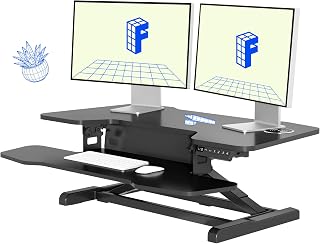
Best for frequent height changes: 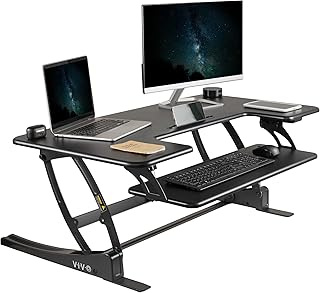
Best for tiny desks under 40 inches wide: Monoprice Workstream by Monoprice Standing Desk Converter — as of May 2026. Compact footprint (under 28 inches wide), manual crank, and a lifting range of 5–18 inches. It’s designed for small spaces and doesn’t overhang narrow desks. Owner reports confirm it’s stable and durable despite the compact design.
Best for all-day standing comfort: 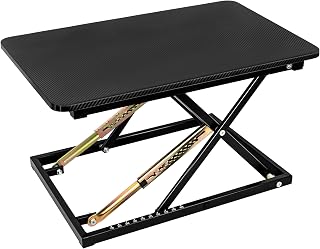
Budget Alternative: Fixed Riser (Not a True Converter)
Best budget alternative: 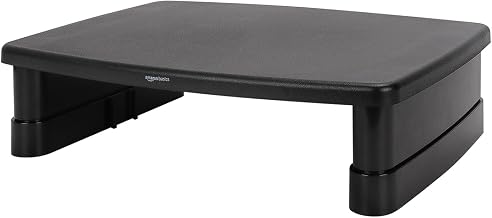
Assembly, Delivery, and Returns
Most converters ship in one or two boxes and assemble in 15–30 minutes with a screwdriver and hex key (included). Per owner reports, assembly is straightforward—no special tools or expertise needed.
Check the return window before buying. Amazon offers 30 days; direct manufacturer sites often offer 14–30 days. A 30-day return window is worth the extra few dollars if you’re uncertain about fit or height, since you can test it in your actual desk setup and return it guilt-free if it doesn’t work.
Shipping weight matters if you’re ordering online. Most converters weigh 20–40 lbs, so shipping costs are reasonable (usually included for Prime members). If you’re in a location with a local office-supply store, buying in-store saves shipping and lets you inspect the converter before committing.
FAQ
Do converters damage my desk surface? Not if your desk is solid wood or laminate. Most converters have rubber or felt feet that protect the surface. Per owner reports on Amazon, damage is rare and typically occurs only if you drag the converter across the desk repeatedly. Place it gently and you’ll have no issues. If your desk has a delicate finish, use a protective mat underneath.
What’s the warranty on budget models? Most sub- converters come with 1–2 year warranties covering defects in materials and workmanship. Manual models typically have longer warranties (2 years) than electric ones (1 year) because they have fewer moving parts. Check the product listing for specific warranty terms before purchasing. Amazon’s A-to-Z guarantee also covers defects within 30 days of delivery.
How long do standing desk converters last? Per aggregated owner reports on Amazon, sub- converters last 3–5 years of daily use before showing wear (loose bolts, slower motor response, minor wobble). That’s comparable to mid-tier full standing desks. Manual models tend to outlast electric ones because they have fewer moving parts, but both are durable if you don’t overload them.
Can I return a converter if it doesn’t fit my desk? Yes, if you buy from Amazon or a retailer with a 30-day return window. Measure your desk and the converter’s footprint before ordering to avoid the hassle, but returns are generally friction-free if dimensions don’t match your setup.
Do I need an anti-fatigue mat with a standing desk converter? Not required, but helpful. An anti-fatigue mat reduces leg and foot strain during long standing sessions. Per owner reports, mats are most noticeable during the first 2–3 weeks of standing work, after which your body adapts. If you plan to stand 2+ hours at a stretch, a mat is a worthwhile add-on.
Wrapping Up
A standing desk converter is one of the best investments you can make for a home office. You get the health benefits of standing work—better posture, more energy, less back pain—without the cost or space commitment of a full standing desk. The models recommended here have proven durability and real owner satisfaction, and they work in apartments, small offices, and shared spaces.
Start by deciding whether you want manual, electric, or gas-spring assist based on how often you’ll switch positions. Then measure your desk to ensure the converter’s footprint fits. Order with a 30-day return window so you can test it in your actual setup. Within a week, you’ll know whether standing work is for you—and if it is, you’ve bought yourself years of comfort and productivity.


