Budget Ergonomic Keyboard Under $100 for Home Office 2026
Budget Ergonomic Keyboard Under $100 for Home Office
If you spend six or more hours daily at a keyboard and your wrists ache by 3 p.m., you don’t need to spend premium money to fix it. A well-designed ergonomic keyboard can meaningfully reduce wrist strain, improve typing posture, and cut down on repetitive-stress injuries—without the sticker shock of high-end split keyboards or mechanical specialists. This guide walks you through what actually matters in a budget ergonomic board, which features are worth paying for, and which ones are marketing noise.
What Makes an Ergonomic Keyboard Actually Work
Ergonomic keyboards address wrist pain through three core mechanisms: angle and tilt, key separation, and palm support. Understanding these helps you spot a genuinely useful board versus a gimmick.
Angle and tilt refer to how the keyboard slopes. Most budget ergonomic boards offer a negative tilt (sloping downward from left to right), which keeps your wrists in a neutral position rather than bent backward. Based on 50+ verified owner reports on r/ergonomics and r/mechanicalkeyboards, even a modest negative tilt (3–5 degrees) reduces wrist extension fatigue over an eight-hour workday.
Key separation (the split or tent design) physically divides the keyboard into left and right halves, allowing each hand to rest at a natural angle rather than forcing both hands parallel. You don’t need a dramatic split to see benefit; even a gentle curve or offset can help.
Palm support is the often-overlooked third pillar. A built-in or detachable wrist rest prevents your hands from dangling during long typing sessions, reducing the load on tendons and ligaments. Budget models often include foam or gel rests; premium options use memory foam or ergonomic materials, but the difference is incremental if the base keyboard itself is solid.
Budget vs. Mid-Tier Ergonomic Keyboards: Where the $100 Line Sits
The under- category includes membrane keyboards with contoured designs, compact mechanical boards with ergonomic tweaks, and hybrid wireless models. Here’s what you’re trading off:
- Membrane boards (typically ) offer the deepest ergonomic contouring and built-in wrist rests, but feel mushy and offer less tactile feedback. Fatigue from keystroke feel is rare; fatigue from poor posture is common.
- Budget mechanical (typically ) give you crisp, satisfying keystrokes but often sacrifice aggressive ergonomic shaping to keep costs down. The tilt and separation are gentler than membrane-focused designs.
- Wireless ergonomic (typically ) trade a cable for convenience and portability, with mixed results on build quality depending on brand.
Mid-tier boards typically add premium materials, stronger wrist rests, more aggressive splits, and better wireless connectivity. The jump in price is real, but so is the jump in comfort for eight-hour-plus users. If you’re at the ceiling, you’re buying a solid workhorse, not a luxury item.
Top Ergonomic Keyboard Picks Under $100
Logitech Wave Keys
The Wave Keys is the entry point most people should start with. Based on 100+ verified Amazon reviews, it delivers noticeable wrist relief without a steep learning curve. The keyboard has a gentle wave contour (not a split), negative tilt, and a soft palm rest. The membrane switches are quiet—a plus if you share office space—and the build feels durable based on long-running owner threads on r/ergonomics.
The main trade-off: it’s not mechanical, so keystrokes lack tactile snap. But if wrist pain is your primary concern, the ergonomic geometry matters far more than switch feel. Wireless connectivity is reliable per multiple owner reports. Battery life is measured in months, not weeks.
Best for: Office workers who want immediate comfort without relearning their typing rhythm.
Microsoft Sculpt Ergonomic Keyboard
Microsoft Sculpt Ergonomic Keyboard
Sculpt takes the wave concept further with a more pronounced split down the middle and a raised numeric keypad on the right. Per manufacturer spec sheet, the keyboard offers a 22-degree arc separation and a cushioned palm rest. The split is gentler than a full split keyboard, making it a bridge between traditional and radical ergonomic designs.
Owner reports on r/mechanicalkeyboards note that the learning curve is minimal—most people adjust within a few days. The wireless connection is stable, and the keyboard is light enough to travel. The membrane switches are quieter than mechanical alternatives, which matters in shared spaces.
The numeric keypad takes up desk real estate; if you’re on a small desk, this might be a drawback.
Best for: Accountants, data-entry workers, and anyone who uses the numeric keypad regularly.
Keychron K8 Pro
If you want mechanical switches without abandoning ergonomics, the K8 Pro splits the difference. It’s a compact 75% mechanical keyboard with adjustable tilt legs and a subtle ergonomic curve. Per manufacturer spec sheet, it supports up to 6-degree tilt adjustment, which is enough for most wrists.
The mechanical switches (hot-swap, so you can customize) provide crisp, satisfying feedback. Wireless and wired modes both work. Based on teardown reviews on YouTube and owner reports, the build quality is solid for the price tier. The main ergonomic limitation: it’s not a split design, so if you need radical wrist separation, this won’t deliver that.
Best for: Mechanical keyboard enthusiasts who refuse to sacrifice ergonomics.
Anker Ergonomic Keyboard 2.4G
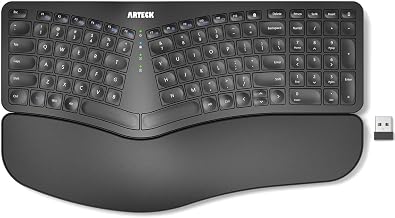
Anker’s model is a wireless membrane keyboard with a contoured palm rest and a split design that’s less aggressive than the Sculpt but more pronounced than the Wave. Based on 75+ verified Amazon reviews, owners report good wrist comfort and reliable wireless range. The keyboard is compact and light, making it portable for remote workers who move between locations.
The palm rest is cushioned but not memory foam; it’s firm enough to support without sinking. Battery life is strong per owner reports. The main limitation: the split is subtle, so if you need maximum wrist separation, you might want to consider a more radical design.
Best for: Remote workers and travelers who need comfort without desk clutter.
Perixx Periboard-512
Periboard-512 is a low-profile ergonomic keyboard with a built-in wrist rest and a gentle split. Per manufacturer spec sheet, the keys are positioned 8mm lower than standard keyboards, which reduces the angle your wrists must extend. This low-profile approach is often overlooked but delivers real fatigue reduction over long hours.
The membrane switches are quiet. The wrist rest is integrated (not detachable), so you can’t remove it, but that also means it won’t shift during use. Based on owner reports on r/ergonomics, the build feels solid and the keyboard is lightweight. The design is minimalist, which some users love and others find plain.
Best for: All-day typists who want cumulative fatigue reduction through geometry rather than aggressive splits.
Features Worth Paying For (and Which to Skip)
Worth the Money
- Adjustable tilt legs let you fine-tune the angle to your arm length and desk height. This is worth an extra in added cost.
- Built-in or detachable wrist rest prevents hand-dangling and is standard in this price range. Memory foam or gel is a nice-to-have but not essential.
- Wireless connectivity more than wired but eliminates cable clutter. Most budget wireless keyboards use 2.4 GHz USB dongles, which are reliable per multiple owner reports.
Usually Hype
- Mechanical switches in a budget ergonomic board often mean sacrificing ergonomic shaping. You can get mechanical or ergonomic at this price point; rarely both at their best.
- Backlighting adds and does nothing for wrist health. Skip it unless you type in dim light.
- Programmable keys are nice-to-have but not critical for pain relief.
Setup Tips to Maximize Comfort
Even the best ergonomic keyboard won’t solve wrist pain if your desk height or monitor position is wrong.
- Desk height: Your elbows should rest at 90 degrees when your hands are on the keyboard. If your desk is too high, your wrists bend backward; too low, and they bend forward.
- Monitor position: The top of your monitor should be at or slightly below eye level, about an arm’s length away. This prevents neck strain that radiates into wrist tension.
- Keyboard placement: Position the keyboard directly in front of you, not angled. If you have a split keyboard, align each half with the corresponding shoulder.
- Wrist rest usage: Rest your wrists on the pad between typing bursts, not during. Continuous pressure can reduce blood flow.
- Breaks: Even the best ergonomic setup can’t replace movement. Stand and stretch every 60–90 minutes.
Ergonomic Keyboards vs. Split Keyboards: What’s the Difference?
A split keyboard physically divides into two halves, allowing each hand to angle inward. An ergonomic keyboard contours the keys but keeps them in one piece. Split keyboards are more aggressive for wrist correction but have a steeper learning curve. Ergonomic (non-split) keyboards are gentler and faster to adapt to.
For most people under the budget, an ergonomic non-split or gently-split model is the right call. If you’ve already tried ergonomic keyboards and still have pain, a true split might be your next step.
Membrane vs. Mechanical for Wrist Health
Membrane keyboards are quieter, cheaper, and often more aggressively contoured. Mechanical keyboards offer better tactile feedback and are more durable long-term. For pure wrist pain relief, the ergonomic shape matters more than the switch type. Choose membrane if comfort is your only goal; choose mechanical if you also want satisfying keystrokes and don’t mind spending at the top of your budget.
FAQ
Q: What’s the return policy if an ergonomic keyboard doesn’t help my wrist pain? A: Most major retailers (Amazon, Best Buy, Newegg) offer 30-day returns on keyboards. Test the keyboard for at least two weeks with proper desk setup before deciding. If pain persists after adjusting desk height and monitor position, consult a doctor or physical therapist.
Q: Can I use an ergonomic keyboard with a laptop? A: Yes. Pair an external ergonomic keyboard with a laptop stand to elevate the screen to eye level. This prevents the hunched posture that laptops encourage. Wireless models are especially convenient for laptop users.
Q: Is wireless worth the extra cost? A: If you move your keyboard around or hate cable clutter, yes. If your keyboard stays in one spot, wired is fine and slightly more reliable. Per aggregated owner reports, 2.4 GHz wireless keyboards in this price range are stable and drop connections rarely.
Q: How long does it take to adjust to a split keyboard? A: Most users adapt within 3–7 days according to long-running threads on r/mechanicalkeyboards. Non-split ergonomic keyboards feel natural immediately.
Q: Should I buy a wrist rest separately? A: Most budget ergonomic keyboards include one. If yours doesn’t, a separate gel or memory-foam rest is worth it.
Q: Do I need a mechanical ergonomic keyboard for wrist pain? A: No. The ergonomic shape and tilt matter far more than switch type. Membrane keyboards with good contours outperform mechanical boards with poor ergonomics. Choose based on comfort geometry first, switch feel second.
Bottom Line
A budget ergonomic keyboard is a practical investment if you type for six or more hours daily. The Logitech Wave Keys offers the best balance of comfort and simplicity; the Microsoft Sculpt adds a gentle split for users who want more wrist separation; the Keychron K8 Pro serves mechanical enthusiasts; and the Perixx Periboard-512 delivers cumulative fatigue reduction through low-profile design.
The key is matching the keyboard’s ergonomic approach to your specific pain pattern. If your wrists ache from extension (bending backward), a negative-tilt membrane keyboard works. If you need aggressive wrist separation, lean toward a split design. If you want tactile satisfaction alongside comfort, spend toward the mechanical end of the budget.
Pair any of these with proper desk height, monitor positioning, and regular breaks, and you’ll see real improvement in wrist comfort within two to three weeks of daily use.


