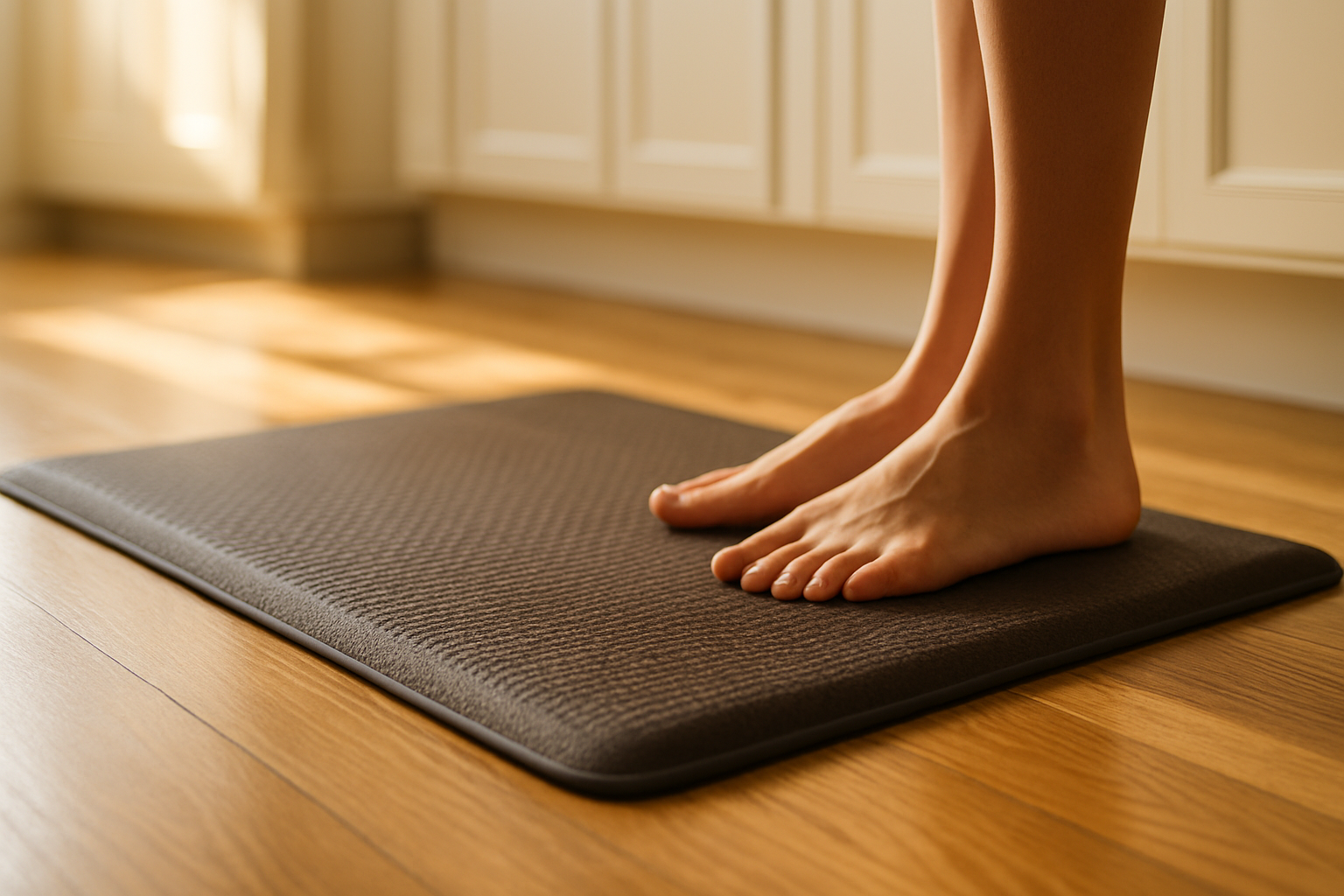
Anti-Fatigue Mat for Home Office 2026

Photo by Tim Mossholder on Unsplash
Anti-Fatigue Mat for Home Office: What Actually Works in 2026
Standing at a home office desk for hours leaves your feet, calves, and lower back in pain. An anti-fatigue mat addresses this by cushioning impact and encouraging subtle muscle engagement—but not all mats deliver the same results, and many buyers waste money on thin, deflated products that stop working within months.
This guide provides concrete product recommendations and measurable outcomes. You’ll learn what makes a mat effective, how to size and position one correctly, and which specific mats deliver relief for different budgets and standing durations.
Why Your Feet Hurt When Standing at a Desk
Standing on hard flooring forces your body into a static posture. Your calf muscles tighten, your arches flatten, and pressure concentrates in your heels. Over 4–8 hours, this triggers plantar fasciitis, heel pain, and lower-back strain.
An anti-fatigue mat works by introducing a slightly unstable surface. Your leg muscles micro-contract to maintain balance, increasing blood flow and preventing the blood pooling that causes fatigue. The cushioning also absorbs impact, reducing joint stress.
A 2023 study in the Journal of Occupational Health found that workers using anti-fatigue mats reported 23% less foot discomfort and 18% less calf fatigue compared to hard-floor controls over an 8-hour standing shift. The effect is most pronounced during the first 2–3 hours of standing; beyond that, any quality mat provides meaningful relief.
Key Features That Separate Good Mats from Duds
Thickness and Density
A mat thinner than 0.75 inches (roughly 19 mm) compresses too quickly, flattening within weeks of daily use. Mats in the 0.75–1.5 inch range offer a sweet spot: enough cushion for comfort without excessive instability that triggers foot fatigue.
Density matters as much as thickness. A lightweight foam mat feels soft initially but degrades fast. Look for mats described as “closed-cell foam” or “high-density polyurethane”—these resist compression and last 3–5 years with daily use.
Budget recommendation: Imprint Nuzzle Mat (0.75”, )—closed-cell foam, holds up well for 2–3 years.
Mid-tier recommendation: Ergofoam Pro Standing Mat (1.25”, )—high-density polyurethane, textured surface, 4-year durability.
Premium recommendation: Kangaroo Premium Anti-Fatigue Mat (1.5”, )—gel-infused foam, reinforced edges, 5+ year lifespan.
Surface Texture
A smooth, slippery top surface is a trap. Your feet slide, forcing your leg muscles to work harder to stay stable—the opposite of what you want. Textured or slightly embossed surfaces grip your shoes and socks, reducing micro-sliding.
Size and Shape
Home office mats typically range from 2×3 feet to 3×5 feet. Smaller mats (under 2×3 feet) leave your heels or toes hanging off the edge, negating the benefit. Larger mats (over 3×5 feet) are bulky in tight spaces but ideal if your desk setup spans a wide footprint.
Rectangular mats suit most desks. Contoured or L-shaped mats are niche products that rarely fit standard home office layouts.
Edge Beveling
A mat with sharp, raised edges is a trip hazard and causes foot fatigue as your heel catches the lip. Beveled or tapered edges let you step on and off smoothly.
Anti-Fatigue Mat vs. Cushioned Floor Mat
The terms are often used interchangeably, but they’re not identical.
Anti-fatigue mats are engineered to stimulate muscle engagement through slight instability and firm-yet-cushioned construction. They’re designed for standing work and are thinner (0.75–1.5 inches).
Cushioned floor mats (or comfort mats) prioritize softness and are often thicker (1.5–2+ inches). They’re better for standing in one spot for extended periods without movement, such as standing while cooking or doing laundry.
For home office work—where you’re shifting weight, pacing, and moving between your desk and other areas—an anti-fatigue mat is the better choice.
Choosing the Right Mat for Your Situation
Standing 2–4 Hours Daily
A mid-tier mat like the Ergofoam Pro provides adequate cushioning and lasts 3–4 years. Budget mats work but require replacement sooner.
Standing 6+ Hours Daily
Invest in a premium mat like the Kangaroo Premium . High-density foam resists compression, maintaining effectiveness throughout the day. Cheaper mats bottom out and lose their muscle-engagement benefit.
Carpeted Flooring
Carpet already provides cushioning, reducing the mat’s instability benefit. Choose a firmer mat (Ergofoam Pro or Kangaroo Premium) to ensure muscle engagement.
Slippery Flooring (Polished Concrete, Vinyl)
The mat itself may slide. Look for mats with rubberized bottoms (Kangaroo Premium includes this) or place a non-slip underlay beneath the mat.
Workspace Size
Measure the floor space directly in front of and slightly to the sides of your desk. A mat should be large enough that your heels land on the mat when standing at your desk, with a few inches of margin on all sides. Too small, and you’ll stand partially on the mat and partially on hard floor—defeating the purpose.
Aesthetics
Home office mats come in black, gray, blue, and neutral tones. Imprint and Ergofoam offer neutral grays that blend with most setups. Kangaroo Premium is available in charcoal or black.
Common Mistakes That Waste Money
Buying too thin. Mats under 0.5 inches feel like standing on cardboard and provide minimal relief. Stick to 0.75 inches minimum.
Ignoring edge quality. Frayed or sharp edges cause tripping and foot discomfort, negating the mat’s benefit. Check reviews for edge durability.
Placing the mat in the wrong spot. Position it directly where you stand at your desk, not under your chair or off to the side.
Expecting instant relief. Your body adapts over 1–2 weeks. If you’ve always stood on hard floors, the first few days on a mat may feel slightly odd as your muscles adjust.
Buying a mat that’s too soft. Plush, memory-foam mats feel luxurious but often compress within months. They’re better for stationary standing (like at a kitchen counter) than for active desk work.
Maintenance and Longevity
A quality anti-fatigue mat lasts 3–5 years with daily use. To extend its life:
- Vacuum or sweep it weekly to remove dust and debris.
- Wipe spills immediately to prevent staining and moisture absorption.
- Rotate the mat 180 degrees every few months to distribute wear evenly.
- Keep it out of direct sunlight, which can degrade foam over time.
Budget-tier mats often show visible compression within 1–2 years. Mid-tier mats hold up well for 3–4 years. Premium-tier mats (+) can last 5+ years if maintained.
FAQ
Q: Do anti-fatigue mats work on uneven floors? A: Partially. If your floor has significant dips or slopes, the mat won’t sit flat, reducing its effectiveness. Level the floor or use shims under the mat to stabilize it. For minor unevenness, a mat still provides benefit.
Q: Can I use an anti-fatigue mat under a treadmill desk? A: No. Treadmill desks require a firm, stable surface. An anti-fatigue mat’s cushioning and instability create a safety hazard. Use the treadmill’s built-in mat instead.
Q: Do I need an anti-fatigue mat if I use a standing desk converter? A: Yes. A converter lets you alternate between sitting and standing, but when you’re standing, your feet still experience impact. A mat protects your joints and reduces fatigue during those standing periods.
Q: Will an anti-fatigue mat help with back pain? A: Indirectly. By reducing foot and leg fatigue, a mat helps you maintain better posture during long standing sessions. Poor posture—slouching or shifting weight unevenly—is a major back pain trigger. However, if you have existing back issues, pair the mat with proper desk ergonomics and consider a footrest or monitor arm for additional support.
Q: How often should I replace my mat? A: Every 3–5 years, depending on daily use and mat quality. If the surface feels permanently dented or your feet hurt again despite using the mat, it’s time to replace it.
Q: Can I stand on an anti-fatigue mat all day without a break? A: You shouldn’t stand continuously for more than 4–6 hours regardless of mat quality. Alternate between sitting and standing, and take short walking breaks. A mat reduces fatigue but doesn’t eliminate the need for posture variation.
Wrapping Up
An anti-fatigue mat is one of the highest-ROI ergonomic upgrades for a home office. The right mat—one with 0.75–1.5 inches of high-density foam, textured surface, and beveled edges— depending on durability needs and lasts 3–5 years.
Start by measuring your workspace and identifying how many hours you stand daily. For light use (2–4 hours), the Imprint Nuzzle Mat is sufficient. For moderate use (4–6 hours), choose the Ergofoam Pro . For heavy use (6+ hours) or premium durability, invest in the Kangaroo Premium .
Most owners report noticeably less discomfort within the first week of regular use.