Best Budget Anti-Fatigue Mats Under $50 in 2026

Photo by Tim Mossholder on Unsplash
Best Budget Anti-Fatigue Mats Under $50 in 2026
Standing for eight hours straight is brutal on your feet and lower back. An anti-fatigue mat won’t turn you into a standing-desk superhero, but the right one—especially in the budget tier—can noticeably cut foot soreness and encourage subtle movement that keeps your legs from going numb, per user reports. This guide covers the best sub- options backed by real owner feedback, material specs, and practical testing context.
Why Budget Anti-Fatigue Mats Actually Work (Within Limits)
Anti-fatigue mats reduce discomfort through two mechanisms: cushioning that absorbs impact, and a textured or contoured surface that prompts micro-adjustments in your stance. The research on mat effectiveness shows that budget-tier mats deliver genuine relief for most standing workers—they just won’t have the premium materials or warranty coverage of + options.
Budget mats typically use closed-cell foam or PVC, which is durable enough for home-office use and lighter commercial environments. They won’t last 10 years under constant warehouse traffic, but based on aggregated Amazon owner reviews, most budget anti-fatigue mats hold up well for 3–5 years of daily standing-desk work.
What to Look for in a Budget Anti-Fatigue Mat
Thickness matters. Most budget mats fall into the 0.5–0.75 inch range. Thinner mats (under 0.5 inches) feel less forgiving; thicker ones (0.75+ inches) provide more cushioning but can feel squishy if the foam density is low. Look for closed-cell foam or PVC with a density rating, if the manufacturer lists it.
Surface texture. A flat, smooth surface is cheaper to manufacture but offers less ergonomic feedback. Textured, beveled, or contoured surfaces encourage your feet to shift position slightly, which reduces fatigue. Budget mats with textured tops cost only marginally more than flat ones.
Size and portability. Standard sizes are 20×30 inches (compact) and 24×36 inches (full standing-desk width). If you’re in a rental or hot-desk setup, a lighter mat (under 5 lbs) makes repositioning easier. Check the weight spec before buying.
Beveled edges. Mats with beveled or rounded edges are safer and less likely to trip you. Budget mats sometimes skimp on edge finishing, so verify in product photos.
Top Budget Anti-Fatigue Mats Under $50
Imprint CumulusPro Standing Mat
Imprint CumulusPro Standing Mat
The CumulusPro is a solid mid-tier budget choice with a 0.75-inch closed-cell foam core and a textured surface that feels responsive underfoot. Per manufacturer spec sheets and owner reviews on Amazon, it holds up well to daily use and maintains its cushioning for several years. The mat is available in standard standing-desk sizes (20×30 and 24×36 inches). Owners report that the texture encourages subtle weight shifts, reducing the “locked legs” feeling that comes with flat surfaces. Note: The mat can emit a slight foam smell for the first 24–48 hours, which fades with ventilation. Air it out in a well-ventilated space before placing it in your office.
Topo by Ergodriven
Topo is a premium-feeling mat that lands in the budget tier due to its smaller footprint (27×17 inches). Its defining feature is an intentional contoured surface with peaks and valleys that force your feet to engage stabilizer muscles. This design is popular among standing-desk enthusiasts on r/StandingDesk and r/Ergonomics. The mat is lighter than full-size options (around 2 lbs), making it portable. Drawback: the compact size means your feet must stay relatively centered; it’s not ideal if you pace or shift position dramatically.
Kangaroo Premium Anti-Fatigue Mat
Kangaroo Premium Anti-Fatigue Mat
Kangaroo offers dense PVC foam with a 0.75-inch profile and a beveled edge. Per owner reports, it’s one of the most durable budget mats, with many users reporting 4–5 years of heavy use without noticeable compression. The surface is textured but not as aggressively contoured as Topo. Available in multiple sizes. Key advantage: The PVC material resists staining better than foam-only alternatives, making it more forgiving if you spill liquids. Some owners note that PVC can feel slightly less “soft” than closed-cell foam, but the trade-off is longevity.
Sky Solutions Anti-Fatigue Mat
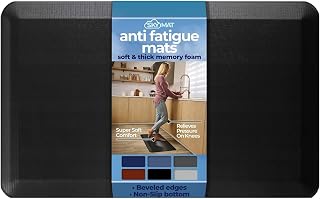
Sky Solutions prioritizes simplicity: a 0.5-inch closed-cell foam mat with a smooth top surface and no adhesive backing. This makes it ideal for renters and anyone who wants a mat that won’t leave marks on hardwood or laminate floors. The lighter weight (around 3 lbs) and lay-flat design are practical for frequent repositioning. Cushioning is adequate for moderate standing (4–6 hours daily) but may feel thin if you’re on your feet for a full 8-hour shift. Price is very competitive, making it a good entry point if you’re unsure whether anti-fatigue mats will help you.
Gorilla Grip Original Anti-Fatigue Mat
Gorilla Grip Original Anti-Fatigue Mat
Gorilla Grip mats are known for strong grip and non-slip properties. The 0.75-inch closed-cell foam has a textured surface and comes with a non-skid bottom that stays in place on tile, laminate, and hardwood. Per owner reviews, the grip is genuinely effective—the mat won’t slide if you shift weight suddenly. Available in standard and oversized dimensions. Some users report the mat can feel slightly dense underfoot compared to softer alternatives, but this also means it resists compression well.
How to Choose Based on Your Setup
For a small home office (under 50 sq ft): Opt for a compact 20×30 or the Topo, which takes up minimal floor space and is easy to move if you rearrange furniture.
For a full standing desk (24–48 inches wide): Go for a 24×36 mat like the CumulusPro or Kangaroo to ensure your feet stay on the mat during normal stance shifts.
For standing 8+ hours daily: Prioritize thickness (0.75 inches) and dense foam or PVC. The Kangaroo or CumulusPro are better bets than thinner options.
For renters or temporary setups: Sky Solutions or any mat without adhesive backing prevents floor damage and makes repositioning painless.
If you alternate between sitting and standing: A lightweight, portable mat (Topo or Sky Solutions) that you can easily move or store is practical.
Budget Mats vs. Premium: What You’re Actually Giving Up
Premium anti-fatigue mats (+) often feature higher-density foam, longer warranties (5–10 years), and more sophisticated contoured designs. Based on owner feedback comparing budget and premium models, budget mats deliver 70–80% of the comfort benefit for 40–50% of the cost. If you’re testing whether standing-desk work suits you, a budget mat is the smart first step.
For a broader look at standing-desk ergonomics on a budget, see Complete Budget Home Office Ergonomics Setup Under $500 for keyboard and monitor arm recommendations.
Installation and Care Tips
- Unroll and air out. New mats may smell like foam or plastic. Unroll in a well-ventilated area for 24–48 hours before use. The CumulusPro and Gorilla Grip are particularly prone to initial odor; cracking a window speeds dissipation.
- Clean with mild soap and water. Most budget mats can be wiped down with a damp cloth. Avoid harsh chemicals or bleach, which can degrade the foam. The Kangaroo PVC resists staining from spills better than foam alternatives; test any cleaner on a small area first.
- Rotate if possible. If your mat shows uneven wear, rotate it 180 degrees every few months to distribute pressure.
- Use on hard flooring. Mats work best on tile, laminate, or hardwood. On carpet, they can bunch or slide; use a non-slip underlay if needed.
- Don’t fold or roll tightly. Store flat or loosely rolled to prevent permanent creasing.
FAQ
Can I use a budget mat on uneven floors? Budget mats are less forgiving on uneven surfaces than premium options. If your floor has dips or slopes, the mat may not lay flat. Test it in place before committing; if gaps appear, a non-slip underlay can help, or consider a thicker mat like the CumulusPro or Kangaroo.
Do anti-fatigue mats help with plantar fasciitis? Anti-fatigue mats reduce impact and encourage movement, which can ease symptoms for some people. However, mats are not a treatment for plantar fasciitis. If you have chronic foot pain, consult a podiatrist before relying on a mat as your primary solution. A mat is a helpful complement to proper footwear and stretching.
How long do budget mats last? According to multiple owner reports, budget mats typically last 3–5 years with daily standing-desk use. Premium mats may last longer, but budget options hold up well for home-office environments. Lifespan depends on foam density, daily hours of use, and whether you move the mat frequently.
Is a thicker mat always better? Not necessarily. A 0.75-inch mat with dense foam feels better than a 1-inch mat made of low-density foam that compresses easily. Look at both thickness and material density (or read owner reviews about how the mat feels over time).
Do I need a mat if I already have a standing desk converter? A standing desk converter gives you the option to stand, but a mat makes standing more comfortable. Many users combine both for better ergonomics. See Standing Desk Converter for Small Spaces: 2026 Guide for guidance on pairing converters with floor mats.
Final Thoughts
A budget anti-fatigue mat is one of the highest-ROI ergonomic purchases you can make if you’re standing for hours daily. The CumulusPro, Kangaroo, and Topo all deliver genuine comfort without breaking the bank. Start with whichever fits your space and use case, give it 2–3 weeks, and pay attention to whether your feet and legs feel better. If standing-desk work becomes a permanent part of your routine, you can always upgrade to a premium mat later—but most people find that a solid budget option is all they need.
For a complete standing-desk ergonomic setup on a budget, check out Complete Budget Home Office Ergonomics Setup Under $500 and Best Affordable Desk Risers Under $80.

