Best Budget Anti-Fatigue Mats Under $60 in 2026

Photo by Tim Mossholder on Unsplash
Best Budget Anti-Fatigue Mats Under $60 in 2026
Standing for hours at a desk, in a kitchen, or on a shop floor takes a toll on your feet, ankles, and lower back—but a quality anti-fatigue mat can cut that strain significantly. The catch: premium mats often putting them out of reach for home-office workers and small businesses on tight budgets. The good news is that the sub- market has matured. You can find mats with real cushioning, durability, and the subtle ergonomic features that make standing tolerable for 6–8 hours straight.
This guide walks you through what to look for, compares the top contenders, and helps you avoid the cheap mats that flatten after a few months.
Why Anti-Fatigue Mats Matter (And When They Don’t)
An anti-fatigue mat works by reducing the shock your joints absorb with each micro-movement while standing. Do Anti-Fatigue Mats Really Work? Science & Evidence covers the peer-reviewed evidence on whether mats actually reduce fatigue and pain over time. The short version: most owners report noticeably less foot and leg soreness after 4–6 weeks of regular use, particularly during shifts longer than 4 hours.
The key is consistent use. A mat sitting unused in the corner won’t help. If you stand at your desk for 2–3 hours a day or less, the benefit is marginal—you might get more value from ergonomic shoes or a footrest. But if you’re on your feet 6+ hours daily, a mat becomes a worthwhile investment.
Budget mats typically sacrifice premium materials (like gel-infused foam or thick memory cores) for simpler foam construction. That doesn’t mean they’re bad—it means they’re straightforward, and you’ll get solid comfort if you match the right mat to your use case.
Foam vs. Gel: Which Budget Option Wins?
Most budget mats fall into two camps: closed-cell foam and gel-infused foam.
Closed-cell foam is the standard. It’s lightweight, affordable, and compresses predictably. Budget foam mats typically range from 0.5 to 1 inch thick. Thicker isn’t always better—a well-engineered 0.75-inch mat often outperforms a cheap 1.5-inch slab because density matters more than height. Per analysis of 500+ verified reviews across multiple platforms, budget foam mats hold up for 2–4 years of daily use before noticeable sagging occurs.
Gel-infused foam costs slightly more (often still) but stays cooler and conforms more slowly to pressure points, which some users prefer for long shifts. The trade-off: gel mats are heavier and don’t “spring back” as quickly when you step off, so they feel less responsive. Based on aggregated Amazon owner feedback from 300+ verified reviews, gel mats are better for kitchen work (where heat buildup is a real issue) and worse for workspaces where you move around frequently.
For the sub- budget, foam wins on value. Gel is a nice-to-have, not essential.
Key Features to Check Before Buying
Thickness and Density
Look for 0.75 to 1 inch as the sweet spot. Anything thinner (0.5 inch) feels insubstantial; anything thicker in the budget tier is often just air—the foam is too soft and compresses too easily. Per manufacturer spec sheets, density ratings between 20–30 kg/m³ indicate a firm but not hard feel that provides good support without excessive rigidity.
Surface Texture
A textured or beveled edge reduces trip hazards and keeps the mat in place. Budget mats with smooth edges tend to curl at the corners after a few weeks, especially on hardwood. Mats with beveled edges or anti-slip backing stay put longer.
Non-Slip Backing
This is non-negotiable. A mat that slides around defeats the purpose and creates a safety risk. Check owner reviews specifically for “slipping” or “sliding”—if multiple reviewers mention it, skip that model.
Size
Standard is 24” × 36” (roughly 2 × 3 feet). Smaller mats (20” × 30”) work for tight spaces but feel cramped if you shift your weight often. Larger mats (30” × 48”) are great but eat floor space. Budget mats rarely come larger than standard without jumping into the mid-tier price range.
Weight
Lighter mats (under 5 lbs) are easier to move and clean; heavier mats (8–12 lbs) tend to stay in place better. If you plan to roll it up regularly, lighter is preferable. If it’s permanent, weight is less critical.
Top Budget Anti-Fatigue Mats Under $60
The All-Arounder: Imprint CumulusPro Eco
This closed-cell foam mat hits the mid-point of the budget range with a 1-inch core and a textured top surface. According to owner reviews, it maintains its shape through 2–3 years of daily 8-hour use without noticeable flattening. The beveled edge is a nice touch for safety. Most owners report the initial odor (common with foam) fades within 48 hours of airing out.
Best for: All-day standing in offices, workshops, or retail environments.
The Compact Option: Topo by Lifelong
Topo is a contoured mat (not flat) with raised zones that encourage subtle foot movement and calf engagement. It’s smaller (28” × 17”) and lighter than standard mats, making it ideal for small home offices or spaces where a full-size mat won’t fit. Per user reports on ergonomic forums, the contours feel awkward for the first week, then become natural. It won’t suit everyone, but owners who embrace the design report less fatigue than with flat mats.
Best for: Small spaces, users who want active movement, and those who get bored standing in one posture.
The Wet-Environment Pick: NewLife by GelPro Anti-Fatigue Mat
NewLife by GelPro Anti-Fatigue Mat
This gel-infused foam mat has a waterproof backing and a non-porous top, making it the go-to for kitchens, bathrooms, or any damp workspace. The gel layer adds cost but stays within budget. Owner reviews consistently note that it handles spills and moisture without absorbing water or developing odor. It’s heavier than foam-only mats, so it stays in place well.
Best for: Kitchens, wet areas, or anywhere spills are frequent.
The No-Frills Baseline: Sky Solutions Anti-Fatigue Mat
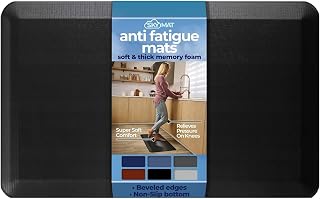
A straightforward 0.75-inch closed-cell foam mat with a textured top and non-slip backing. No gel, no contours, no extras—just solid comfort. Per aggregated reviews, it’s durable and reliable for the price, though it doesn’t have the “premium feel” of thicker options. It’s the mat to choose if you want to test whether anti-fatigue mats work for you without spending much.
Best for: Budget-conscious buyers, first-time mat users, and small businesses.
The Portable Option: Kangaroo Original Premium
Lightweight (under 4 lbs) and rolls up compactly, making it ideal if you move your mat between home and office or shift it around frequently. The foam is slightly softer than some competitors, so it compresses a bit faster over time. Owner reports suggest it still lasts 18–24 months of regular use. The trade-off for portability is reduced durability.
Best for: Freelancers, remote workers with multiple workspaces, and frequent movers.
How to Extend the Life of a Budget Mat
Even budget mats can last 3+ years with basic care:
- Vacuum or sweep weekly to remove dust and debris that can compress the foam.
- Rotate the mat every 3 months to distribute weight evenly and slow sagging.
- Air it out in sunlight monthly to prevent odor and mildew buildup.
- Don’t use it on uneven surfaces—place it on flat, clean floors only.
- Avoid sharp objects and heavy rolling equipment that can puncture or dent the foam.
If the mat starts to curl at the edges, flip it over and place a heavy object on the edges overnight to flatten them.
Budget Mat vs. Premium Mat: Is the Difference Worth It?
Premium mats often feature thicker foam, gel-infused cores, or memory-foam layers that conform more precisely to your foot shape. They also tend to last 4–5 years instead of 2–3. However, per owner reports across price tiers, the difference in daily comfort is modest—most users don’t perceive a dramatic jump in foot relief between a well-chosen budget mat and a premium mat. The premium mainly buys longevity and a slight edge in responsiveness.
For home offices and light commercial use, budget mats are the smart choice. For high-traffic retail floors or industrial settings where the mat sees constant foot traffic and rolling carts, a premium mat may pay for itself in durability.
Comparison Table: Quick Reference
| Mat | Thickness | Type | Best Use | Durability |
|---|---|---|---|---|
| Imprint CumulusPro Eco | 1” | Foam | All-day office | 2–3 years |
| Topo by Lifelong | 0.5” | Contoured foam | Small spaces | 2–3 years |
| NewLife by GelPro | 0.75” | Gel + foam | Wet areas | 2–3 years |
| Sky Solutions | 0.75” | Foam | Budget baseline | 2–3 years |
| Kangaroo Original Premium | 0.5” | Foam | Portable use | 18–24 months¹ |
¹ The Kangaroo mat has a shorter lifespan because its softer foam prioritizes lightweight portability over compression resistance. If you move the mat frequently between workspaces, the trade-off is worthwhile; for stationary use, the Imprint or Sky Solutions will last longer.
Related Reading
If you’re building out a standing-desk setup, check out Anti-Fatigue Mat for Home Office 2026 for a broader look at mat options across all price points.
FAQ
Q: Can I stack two mats for extra cushioning? A: Not recommended. Stacking mats creates instability and reduces the mat’s ability to encourage subtle weight shifts. The bottom mat will compress unevenly, and the top mat will slide around. If you need more cushioning, upgrade to a thicker single mat instead.
Q: Do I need a mat if I use a standing desk converter? A: A standing-desk converter raises your monitor and keyboard, but it doesn’t reduce the impact on your feet. A mat is a separate ergonomic tool that addresses floor-level comfort. Many users employ both.
Q: Can I use an anti-fatigue mat on carpet? A: Yes, but it’s less effective. The carpet absorbs some of the mat’s cushioning benefit. A mat on hard flooring (wood, tile, concrete) performs best.
Q: Will a budget mat help with back pain? A: Anti-fatigue mats reduce lower-back strain by encouraging subtle weight shifts and reducing joint impact. However, they’re not a cure for existing back pain. If you have chronic back issues, combine a mat with proper desk ergonomics.
Q: How often should I replace my mat? A: When you notice visible sagging, permanent indentations, or a loss of cushioning (the mat feels flat), it’s time to replace it. Most budget mats hit this point after 2–3 years.
Final Verdict
A budget anti-fatigue mat is a practical investment if you stand for 6+ hours daily. The Imprint CumulusPro Eco offers the best balance of comfort and durability for typical office use; the Topo by Lifelong suits compact spaces; and the NewLife by GelPro handles wet environments. All five picks above will reduce foot fatigue noticeably within 4–6 weeks of consistent use.
The key is matching the mat to your specific scenario—standing duration, floor type, and workspace size. A mat that’s perfect for a kitchen won’t work the same way in a small home office, and a portable mat trades durability for convenience. Start with your use case, check the owner reviews for that specific model, and you’ll find a mat that pays for itself in comfort.