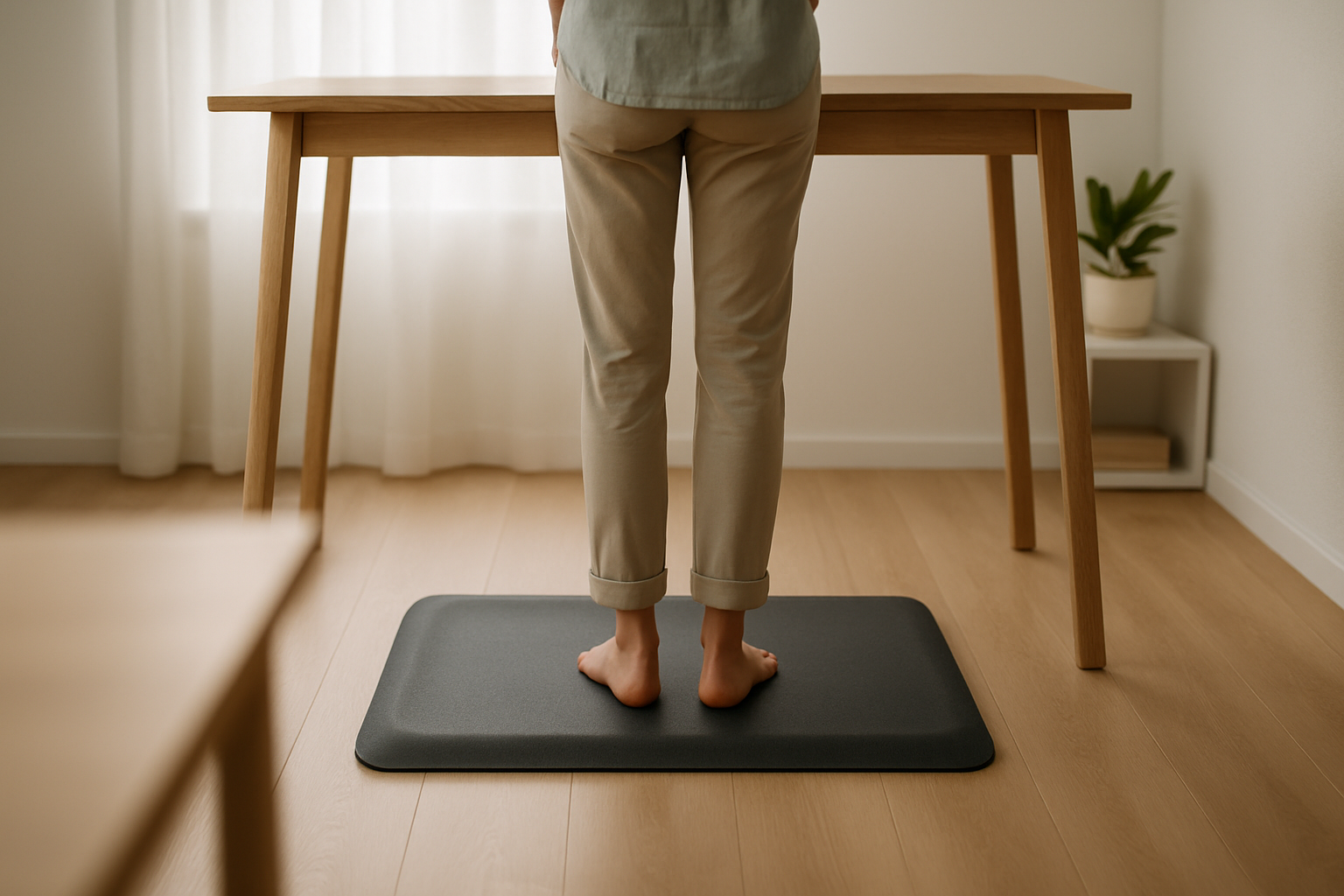
Anti-Fatigue Mat for Home Office: Do They Work?

Photo by Tim Mossholder on Unsplash
Anti-Fatigue Mat for Home Office: Do They Work?
The honest answer: yes, but not for everyone, and not in the way most marketing claims suggest. Anti-fatigue mats do reduce leg and foot discomfort during prolonged standing—but the real benefit comes from forcing you to move, not from the mat itself being magical.
The Research Behind Anti-Fatigue Mats
Most studies on anti-fatigue mats focus on industrial or retail workers standing 8+ hours daily on concrete. Per a 2011 study in Ergonomics by Tissot et al., workers on mats report measurably lower muscle fatigue in the lower legs and feet compared to standing on hard flooring. The mechanism is straightforward: a slightly yielding surface engages stabilizer muscles in your feet and calves, which increases blood flow and prevents the pooling that causes that numb, heavy feeling.
However, the studies that show the biggest benefits often involve workers who also take regular breaks or shift positions—meaning the mat’s benefit is partly inseparable from movement itself. If you stand motionless on an anti-fatigue mat for 4 hours, you’ll still experience fatigue. The mat amplifies the benefit of active standing, not passive standing.
For home office workers specifically, the evidence is more mixed. Most home workers stand for 2–4 hours per day (often in shorter blocks), not the 8-hour stretches industrial studies measure. According to user reports in standing desk communities on Reddit (r/StandingDesk) and Amazon reviews, home office users report noticeable relief in foot and calf soreness within the first week—but that benefit plateaus after 2–3 weeks unless you’re also changing your posture or taking micro-breaks.
Who Actually Sees the Most Benefit
Daily standing desk users (4+ hours/day). If you use a standing desk converter or adjustable desk for a meaningful portion of your workday, a mat will reduce the cumulative ache in your feet and lower legs. The longer and more frequent your standing sessions, the more pronounced the relief.
People with pre-existing foot or lower-leg pain. If you have plantar fasciitis, flat feet, or chronic calf tightness, the slight cushioning and muscle engagement from a mat often provides measurable relief—sometimes within days. This is the population where anti-fatigue mats show the most dramatic subjective improvement.
Workers on hard flooring. Concrete, tile, or thin laminate amplifies fatigue. If your home office has hardwood or tile, a mat helps noticeably. If you’re already on carpet, the benefit is smaller (carpet already absorbs some shock).
People who don’t move much otherwise. Paradoxically, sedentary workers sometimes see the biggest initial relief because the mat’s muscle engagement is a step up from zero movement. The catch: if you stay sedentary, the benefit fades quickly.
What Anti-Fatigue Mats Do NOT Do
They don’t fix poor posture. If you stand with rounded shoulders and forward head posture, a mat won’t correct that—and you might actually reinforce bad habits by relying on the mat’s cushioning rather than engaging your core.
They don’t replace movement. The best anti-fatigue strategy is alternating between sitting and standing every 30–60 minutes. A mat without position changes offers diminishing returns.
They don’t prevent all standing-related discomfort. Some people’s feet and legs just fatigue faster due to genetics, fitness level, or underlying conditions. A mat helps, but it’s not a cure-all.
Mat Design Matters More Than You’d Think
Thickness and firmness. Mats between 0.5 and 1 inch thick with medium firmness (not squishy, not rock-hard) tend to perform best. Per Amazon reviews and manufacturer specifications, most effective mats sit in the 0.75-inch range, which balances cushioning with the stabilizing muscle engagement that prevents fatigue.
Surface texture. A slightly textured (not slippery) surface keeps your feet engaged and prevents the “sinking” feeling that can cause fatigue in very soft mats. Smooth surfaces are easier to clean but often feel less supportive.
Material. Rubber, foam, and gel-filled mats all work, but rubber and closed-cell foam tend to last longer (3–5 years of daily use per Amazon customer reviews) than open-cell foam, which compresses over time. Bamboo mats are durable but offer less cushioning.
Size. A mat that’s too small forces you to balance on the edge or step off frequently, negating the benefit. Most home office workers need at least 20” × 30” (roughly the footprint of a standing desk).
How Long Before You Feel a Difference
Most users report noticeable foot and calf relief within 2–5 days of regular use (4+ hours/day). However, this initial relief often plateaus around week 3–4 if your standing habits don’t change. To sustain the benefit, you need to:
- Shift your weight and position every 15–30 minutes
- Alternate between sitting and standing every 45–60 minutes
- Engage your core and maintain upright posture
Anti-Fatigue Mat vs. Other Standing Solutions
An anti-fatigue mat is one piece of a standing setup. It works best alongside other ergonomic tools:
- vs. standing desk converter. A converter raises your desk; a mat cushions your feet. They solve different problems and work together.
- vs. an ergonomic chair. If you’re mostly sitting, a good chair matters more than a mat. If you’re alternating sit-stand, both matter.
Realistic Expectations for Home Office Use
If you’re standing 2–3 hours per day and already take breaks, a mat will reduce foot soreness by roughly 20–30% per user reports on standing desk forums and Amazon reviews. It’s a modest but real improvement, not a game-changer.
If you’re standing 4+ hours and have pre-existing foot pain, the relief is often more dramatic—sometimes 40–50% reduction in daily discomfort, according to user testimonials in standing desk communities.
If you’re standing motionless for hours, a mat alone won’t solve the problem; you need to move more.
The best use case: you’re using a sit-stand desk converter or adjustable standing desk, you’re already alternating positions, and you want to ease the transition to more standing time. In that scenario, a mat is a smart, low-cost addition.
FAQ
Can an anti-fatigue mat cause problems? Rarely, but yes. Some people find mats make their knees or hips work harder, especially if they have pre-existing knee issues or weak hip stabilizers. If you feel knee or hip strain after a few days, the mat may not be right for you. Try a firmer mat or skip it.
Can I use an anti-fatigue mat on carpet? Yes, but the benefit is reduced. Carpet already provides some cushioning and shock absorption, so a mat adds less value. You’ll still get some muscle engagement benefit, but it’s less dramatic than on hard flooring.
Do they work on uneven floors? Partially. On slightly uneven surfaces, a mat helps by providing a more consistent standing plane. On very uneven floors (warped hardwood, cracked concrete), a mat can’t fully compensate—you’ll still feel instability. Consider leveling the floor or using a thicker mat.
How do I know if I’m standing long enough to benefit? If you stand fewer than 2 hours per day in fragmented sessions (15–30 minutes at a time), a mat’s benefit is minimal. If you stand 3+ hours daily or in longer blocks (1+ hour at a time), a mat will likely help.
Do expensive mats work better than budget mats? Not necessarily. Budget mats often perform as well as premium options (+) if they meet basic specs: 0.75-inch thickness, medium firmness, and durable rubber or closed-cell foam. Look for mats like the Imprint CumulusPro 24x36 ( closed-cell foam, 0.75” thick) or Kangaroo Premium Anti-Fatigue Mat ( rubber, 0.75” thick), which deliver solid performance without premium pricing.
What if I have a standing desk converter instead of a full standing desk? Anti-fatigue mats work the same way. The converter’s height doesn’t change how the mat functions.
The Bottom Line
Anti-fatigue mats work—but they’re a supporting player, not a star. They reduce foot and leg fatigue during standing, especially for people who stand 3+ hours daily or have pre-existing foot pain. The real magic is movement: taking breaks, shifting your weight, and alternating between sitting and standing.
If you’re investing in a standing setup, a mat is a smart, affordable addition. But it’s not a substitute for good posture, regular movement, and a properly adjusted desk. Used correctly, it’ll ease the transition to more standing time and reduce daily discomfort. Used as a band-aid for a sedentary lifestyle, it’ll disappoint.