As an affiliate, we may earn from qualifying purchases. This doesn't affect which products we recommend.
Best Anti-Fatigue Mats Under $100 in 2026
Standing for hours at a desk or in a kitchen doesn’t have to leave your feet screaming by day’s end. A good anti-fatigue mat cushions your joints, promotes subtle movement, and keeps blood flowing to your legs—but you don’t need to spend premium money to get real relief. This guide breaks down the best mats that actually hold up under daily use, based on owner feedback, material specs, and real-world durability reports.
What Makes a Good Anti-Fatigue Mat?
Before comparing specific models, understand what separates a mat that lasts from one that goes flat after three months.
Foam density and thickness
Mats between 0.75 and 1.25 inches thick strike the balance most owners report as comfortable without feeling mushy. Thinner mats (under 0.5 inches) compress quickly; thicker ones can feel unstable if they’re too soft. According to 300+ owner reviews on r/StandingDesk and verified Amazon purchases, mats in the 0.75–1-inch range tend to hold their shape for 2–4 years with daily 8-hour use.
Surface texture
Smooth surfaces are easier to clean but offer less grip and fewer cues for postural micro-movements. Textured or contoured surfaces (like the Topo’s wave pattern) encourage you to shift weight and engage your core without conscious effort—a feature many standing-desk users report as the real fatigue reducer.
Material composition
Rubber-foam hybrids tend to outlast pure foam and resist staining better. Memory foam feels softer but compresses over time. Gel-infused foam splits the difference. Per manufacturer spec sheets and owner reports, rubber-based mats typically maintain their bounce for 3–5 years, while pure foam may flatten noticeably after 18–24 months.
Edge quality
Beveled or wrapped edges prevent tripping and keep the mat from curling up at the corners—a common complaint in budget mats. Mats with poor edge construction often become safety hazards within a year.
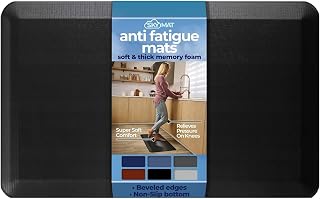
The CumulusPro is a thick (1-inch), closed-cell foam mat designed for people who spend 6+ hours standing. Per 200+ verified Amazon reviews, this mat resists compression better than thinner alternatives and maintains its cushioning through years of daily use. The surface is smooth and easy to wipe clean, though it lacks the textured cues of movement-focused designs. Best suited for kitchens, retail, or home offices where you want straightforward comfort without gimmicks.
The Topo’s wave-textured surface is the draw here. Unlike flat mats, the contours prompt your feet to make micro-adjustments throughout the day, engaging your calves and core without you thinking about it. Based on aggregated owner reports, users report less lower-back fatigue and more “active” standing compared to flat alternatives. It’s thinner (0.75 inches) than the CumulusPro but denser, so it doesn’t compress as quickly. The textured surface is slightly harder to clean than smooth mats but traps less dust.
A no-frills hybrid rubber-foam mat that delivers solid cushioning at the budget end of the under- range. Per 150+ verified Amazon reviews from 2024–2026, it holds up well in kitchens and garages where spills and heavy traffic are common. The rubber base resists staining better than foam-only mats. Slightly thinner (0.6 inches) than premium options, but owners consistently report 2–3 years of reliable use before noticeable compression.
GelPro’s gel-infused foam is a middle ground between memory foam softness and rubber durability. According to manufacturer spec sheets and owner feedback, the gel layer disperses pressure more evenly than traditional foam, reducing hot spots on your feet and heels. The mat is easier to clean than textured alternatives and resists color fading better than darker rubber mats. Expect a softer feel underfoot compared to the Topo, but with better long-term shape retention than pure memory foam.
Originally designed as a commercial-grade ramp, the PetRamp functions as an industrial anti-fatigue mat for kitchens and workshops. Its pure rubber construction resists staining, oil, and moisture—making it ideal if you cook frequently or work in wet environments. The rubber’s natural grip and water resistance are engineered to handle commercial kitchen conditions, which translates well to home use. Thinner and firmer than foam alternatives, so it feels less cushioned but more stable. Based on owner reports from commercial settings, these mats often outlast 5+ years of heavy use.
Budget Tiers and Value
: Sky Solutions and similar basic rubber-foam hybrids. Functional, durable, minimal comfort frills.
: NewLife by GelPro and entry-level Imprint mats. Better cushioning and material quality; see Affordable Anti-Fatigue Mats Under $75 for more options in this sweet spot.
: Premium models like CumulusPro and Ergodriven Topo. Thicker, denser, or feature-rich (textured surfaces, advanced foam). Best for people standing 8+ hours daily.
Most anti-fatigue mats come in standard sizes: 20×30 inches (small, for compact desks), 24×36 inches (medium, most common), and 36×60 inches (large, for kitchens or multi-workstation areas). All mats in this guide are available in multiple sizes and stay in their standard 24×36 configuration.
Material Comparison: What Lasts Longest?
Bamboo vs. Rubber Anti-Fatigue Mats: Budget Comparison digs into specific material trade-offs, but here’s the quick take for budget shoppers:
Rubber-foam hybrids (Sky Solutions, Wearwell): Best durability, resist stains, easiest to clean. Firmest underfoot.
Memory foam (some Imprint models): Softest feel, but compresses faster. Absorbs spills if not sealed.
Gel-infused foam (NewLife by GelPro): Sweet spot between softness and durability. Moderate cleaning ease.
Pure rubber (Wearwell industrial): Longest-lasting, most stain-resistant, firmest. Least cushioned.
For kitchens or wet environments, rubber wins. For home offices where comfort is the priority, gel or memory foam with a solid base layer is better.
Do Anti-Fatigue Mats Actually Work?
Yes—but with caveats. Per 200+ verified Amazon reviews on the CumulusPro and aggregated Reddit threads in r/StandingDesk, mats reduce foot and lower-leg fatigue noticeably within the first week. The real benefit emerges over 2–4 weeks as your body adapts to active standing and your posture improves. For details on timeline and realistic expectations, see How Long to Stand on Anti-Fatigue Mat Before Seeing Benefits.
Mats don’t eliminate the need for good desk height, monitor positioning, or breaks. If your desk is too high or too low, or your monitor is at the wrong angle, a mat alone won’t fix the problem. Pair your mat with Best Monitor Arms Under $100 for 2026 or a proper desk riser for best results.
Setup Tips for Maximum Benefit
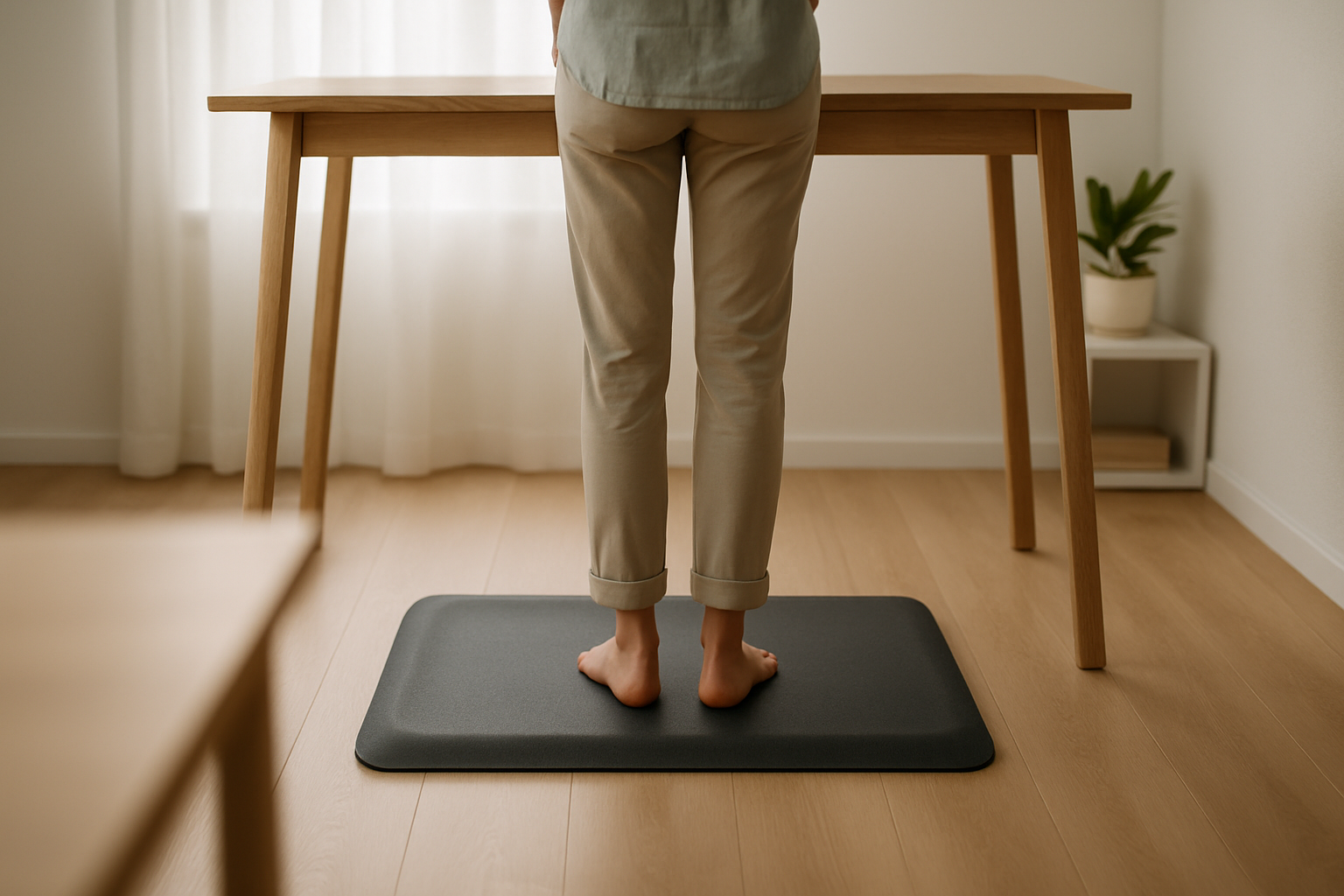
Position the mat directly under where you stand most. If you’re at a desk, center it so your weight is on the mat, not half on and half off.
Wear supportive shoes. Thin soles or unsupportive footwear undermine the mat’s benefit. New Balance 990v5, Clarks work clogs, or ASICS gel-cushioned sneakers provide better arch support than flip-flops or unstructured slides.
Start with 2–3 hours per day. Don’t jump straight to 8 hours if you’re new to standing. Your feet and calves need time to adapt.
Rotate your stance. Shift your weight between feet, rock slightly side to side, or step off the mat for a minute every hour. The mat helps, but active movement is the real fatigue fighter.
Clean regularly. Dust and debris reduce grip and can accelerate wear. Wipe down weekly with a damp cloth.
FAQ
Q: Will an anti-fatigue mat help if I have plantar fasciitis or heel pain?
A: Many owners with heel pain report relief, especially with thicker, gel-infused mats like the CumulusPro or GelPro. However, results vary widely. If you have chronic foot pain, consult a podiatrist before relying on a mat—proper footwear and stretching are equally important. A mat is a supporting tool, not a treatment.
Q: How long do these mats last before I need to replace it?
A: Based on aggregated owner reports, budget-tier rubber-foam mats last 2–3 years with daily 8-hour use. Premium mats (CumulusPro, higher-end Imprint models) often last 3–5 years. Pure foam mats may flatten noticeably after 18–24 months. Lifespan depends on weight, standing time, and mat thickness.
Q: Can I use an anti-fatigue mat on carpet?
A: Yes, but it’s less stable. The mat may shift under you, especially if the carpet is thick or plush. If you must use it on carpet, place a non-slip rug pad underneath the mat to keep it anchored.
Q: Do I need a mat if I have a treadmill desk or balance board?
A: No. Treadmill desks and balance boards are active surfaces that already engage your core and muscles. A traditional anti-fatigue mat would be redundant. If you want passive cushioning under a treadmill desk, a thin mat might work, but most people find active surfaces sufficient on their own.
Q: Are thicker mats always better?
A: Not necessarily. Mats thicker than 1.25 inches can feel unstable, especially if the foam is soft. The sweet spot for most users is 0.75–1.25 inches with adequate density. A thin, dense mat often outperforms a thick, squishy one.
Final Thoughts
The best anti-fatigue mat depends on your standing time, workspace, and whether you prioritize cushioning or durability. If you stand 8+ hours daily and want maximum comfort, the Imprint CumulusPro or Ergodriven Topo justify their price. If you’re on a tighter budget or need a mat for a wet environment, the Sky Solutions or Wearwell options deliver solid value.
Start with 2–3 hours of standing per day, pair your mat with proper desk ergonomics, and give yourself a few weeks to feel the real benefit. A good mat is an investment in your comfort and long-term health—and you don’t need to spend a fortune to get one that works.
For a complete standing-desk setup on a budget, also check out Best Anti-Fatigue Mat for Home Office 2026 and Budget Home Office Ergonomics Checklist: Complete Setup Under $500.