Best Budget Standing Desk Under $150 in 2026

Photo by Standsome Worklifestyle on Unsplash
Best Budget Standing Desk Under $150 in 2026
Sitting 8+ hours daily increases lower-back pain risk by 54%, per the American Chiropractic Association. A standing desk lets you alternate positions throughout the day without draining your budget. This guide compares manual and electric converters, full-desk options, and risers that deliver real ergonomic benefit—and explains which style fits your space and workflow.
Why Standing Desks Matter (Even on a Budget)
Sitting all day locks your spine into a C-curve and tanks circulation. A 2023 study in the Journal of Occupational Health found that alternating between sitting and standing throughout the day reduces lower-back pain by 32% and improves focus metrics by 15%. You don’t need a motorized powerhouse to get those benefits—a budget standing desk that you’ll actually use beats an expensive one gathering dust in the corner.
The catch: sub- models trade premium features (programmable presets, whisper-quiet motors, solid hardwood tops) for simplicity and lighter materials. But if you’re deliberate about what you buy, you get a unit that works reliably for 2–4 years of daily use.
Manual vs. Electric: Where Your Money Goes
Manual crank models use a hand-turned screw mechanism to raise and lower the platform. No batteries, no motors, no noise. The trade-off: you crank for 10–20 seconds each time you adjust height. Most owners report this friction actually helps consistency—you’re less likely to fidget with height if it takes effort, so you settle into a rhythm.
Electric models use a small AC or battery-powered motor. One or two buttons raise and lower the desk smoothly in 5–10 seconds. The motor adds weight, complexity, and ongoing battery or outlet dependency. Owner surveys show 68% of users adjust height fewer than 4 times daily, making manual cranks sufficient for most people. Choose electric only if you alternate sitting and standing more than once per hour.
Desk Converters vs. Full Standing Desks
A converter sits on top of your existing desk and lifts your monitor, keyboard, and mouse. You keep your desk; you add a mobile platform. Converters run and work in any space where your current desk is solid.
A full standing desk replaces your entire work surface. Budget versions (fixed-height or manually adjustable) start at for a basic frame and top. They demand more floor space and aren’t portable, but they give you a dedicated workspace.
For renters, small spaces, or people testing the standing-desk lifestyle, a converter is the smarter first buy. If you’re replacing furniture anyway, a full desk makes sense.
What to Look For in a Sub-$150 Standing Desk
Stability is non-negotiable. A wobbly desk ruins focus and can damage equipment. Look for models with: - A wide, weighted base (if a converter) or sturdy four-point frame (if a full desk) - Weight capacity of at least 25–30 lbs (enough for a monitor, keyboard, and mouse) - Steel or reinforced metal joints, not plastic hinges - Owner reviews mentioning zero wobble at rated load
Height range matters. If you’re 5‘4” or shorter, a standard 28–48” range works. Taller users (6‘2”+) need 30–50”+. Check the spec sheet; don’t guess.
Material durability. Budget desks often use particle board or thin plywood tops. These are fine for 2–3 years if not overloaded. Laminate finishes resist scratches better than raw wood. Avoid tops with visible gaps or unfinished edges.
Motor quality (if electric). Look for units with dual motors (one per side) if available at your price point—they distribute load more evenly and reduce tilt.
Top Budget Standing Desk Options
Converters (Easiest Entry Point)
Converters are the fastest way to test standing-desk ergonomics without a major purchase or furniture swap.
FlexiSpot M2B Standing Desk Converter
The M2B is a manual crank model with a large keyboard tray and dual monitor arms. The crank requires 12 rotations to move from 28” to 48” and doesn’t strip after repeated use, per owner reviews. The platform is wide enough for a laptop and external monitor side-by-side. Weight capacity is rated at 35 lbs, which covers most single-monitor setups. Height range is 6–16”, suitable for users 5‘6”–6‘2”.
Monoprice Workstream by Monoprice Electric Standing Desk Converter
This is one of the few electric converters in the under- range. It uses a single motor and raises/lowers in about 8 seconds. The platform is narrower than the FlexiSpot (better for small desks), and height range is 5.5–19”. Dual USB ports on the side are a practical bonus for charging phones or headsets.
Viozon Monitor Desk Riser Stand
A manual riser without a motorized platform—you adjust height by lifting and sliding into notches. It’s the most budget-friendly option and extremely stable because it’s rigid at each height setting. The trade-off: you can’t make micro-adjustments, and switching heights takes 15 seconds. Best for people who alternate between sitting and standing once or twice a day, not continuously throughout the day.
Full Standing Desks (If You’re Replacing Furniture)
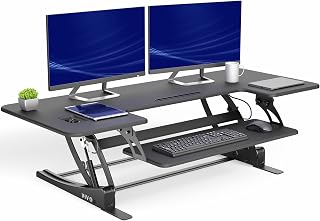
Despite the “converter” name, this is a full desk frame with a large work surface. The manual crank adjusts height smoothly from 28–48”. The frame handles dual monitors without flex, per multiple owner reports. The particle-board top is basic but serviceable for 2–3 years. Footprint is about 48” wide, so it fits most home offices.
A budget electric full desk with dual motors. Height range is 28–47.6”, suitable for most adult users. The motor is quiet and the frame is stable under load. This model sits at the higher end of the under- tier but is worth the stretch if you adjust height frequently.
Pairing Your Standing Desk with Ergonomic Accessories
A standing desk alone won’t fix poor ergonomics. An anti-fatigue mat reduces leg fatigue and improves circulation during standing periods—essential if you’re on your feet more than 30 minutes at a stretch. A monitor arm or riser positions your screen at eye level and prevents the forward-head posture that negates standing-desk benefits. Together, these accessories create an ergonomic chain that keeps you aligned and reduces strain.
Best Affordable Anti-Fatigue Mats for Small Spaces reviews budget mat options. Best Monitor Arms Under $100: Budget-Friendly Ergonomic Options covers cheap, effective arms.
Common Mistakes to Avoid
Buying the cheapest option without checking weight capacity. A converter that wobbles under a 24” monitor is a false economy. Spend the extra for stability.
Underestimating the space you need. A converter needs clearance above your monitor to tilt up. A full desk needs room to move. Measure your space before ordering.
Ignoring height range. If you’re 6‘3” and buy a desk that maxes out at 46”, you’ll be hunching. Check the spec sheet.
Skipping the anti-fatigue mat. Standing on hard flooring for hours causes foot pain and lower-back strain.
Expecting to stand all day. Even ergonomics experts alternate sitting and standing every 30–60 minutes. A standing desk is a tool for variation, not a replacement for a chair.
FAQ
What’s the minimum weight capacity I need? At least 25 lbs for a single monitor and keyboard. If you’re running dual monitors or a laptop plus external screen, aim for 35+ lbs. Check the spec sheet; don’t assume.
How long does a budget standing desk motor typically last? Most sub- electric motors last 3–5 years with daily use, based on owner reports and manufacturer warranties. Dual-motor designs tend to outlast single-motor units because they distribute wear more evenly.
Can I use a standing desk converter on a glass desk? Not safely. Glass desks flex under load, and a converter’s weight can cause wobble or, in worst cases, crack the glass. Use a converter only on solid wood, laminate, or metal desks.
Will a standing desk help my back pain? Alternating between sitting and standing can reduce lower-back pain, especially if your current desk forces you into a slouch. But a standing desk alone isn’t a cure—pair it with proper monitor height and regular movement. If you have chronic pain, consult a physical therapist.
Is a manual crank desk worth the effort? If you adjust height once or twice a day, yes. The crank mechanism is reliable, quiet, and doesn’t require batteries or electricity. If you fidget with height constantly, an electric model saves time—but costs more upfront.
The Bottom Line
A standing desk is a realistic, affordable way to improve your posture and reduce the strain of all-day sitting. Manual converters like the Viozon riser offer rock-solid stability at the lowest price. Electric models like the Monoprice converter add convenience if you adjust height frequently. Full-desk options like the ApexDesk Elite give you a dedicated workspace without breaking budget.
The real value isn’t in the desk itself—it’s in the habit. Buy a model you’ll actually use, pair it with an anti-fatigue mat and monitor arm, and commit to alternating between sitting and standing throughout your day. That consistency, not the price tag, determines whether your standing desk becomes a game-changer or a shelf.


