Best Headphones for Focus: Why Studio Monitors Win
Best Headphones for Focus and Concentration: Why Studio Monitors Beat Consumer Headphones
If you can’t concentrate with your current headphones, the problem probably isn’t willpower — it’s the tuning. Consumer headphones are engineered to sound exciting in a showroom, which means boosted bass and peaky treble that your brain has to work to ignore. Studio monitor headphones are engineered for the opposite: a flat frequency response that fades into the background. That difference matters more than noise cancellation for deep work.
Why bass-heavy headphones sabotage deep work
Walk into any electronics store and demo the popular consumer models. The bass thumps, the cymbals sparkle, vocals sit forward. It’s a pleasant first impression — but those “pleasant” colorations are the audio equivalent of a highlighter running over every page of a book. Nothing recedes.
Three things happen during a long focus session with heavily tuned headphones, based on owner feedback:
- Listening fatigue builds quickly. Boosted low-end and treble peaks force your auditory system to keep adapting, which burns mental bandwidth you’d rather spend on work.
- Masking gets worse. Exaggerated bass masks midrange detail, so any speech or lyrics in your focus playlist get harder to tune out — you catch fragments instead of letting them blur.
- Volume creep happens. When a signature is V-shaped, the midrange feels “missing,” so you crank the volume to compensate. Higher volume = faster fatigue.
Studio monitor headphones were designed for audio engineers who mix for 8-10 hours a day. The whole point is that they don’t editorialize.
What “flat frequency response” actually means for focus
Flat response means the headphones try to reproduce audio with minimal coloration — roughly equal emphasis across bass, mids, and treble, within the limits of what any closed-back headphone can do. Per manufacturer spec sheets for entry-level studio models, response curves typically cover 15 Hz to 20+ kHz with gentle rolloff rather than the sculpted bumps you’ll see measured on consumer cans.
For focus work, flat response translates into a few practical wins:
- Music and ambient tracks sit in the background instead of demanding attention.
- Speech on podcasts and lectures stays intelligible at lower volumes, because the midrange isn’t scooped.
- You can wear them longer before ear fatigue kicks in — many owners report comfortable 3-4 hour stretches on entry-level monitors like the ATH-M20x and MDR-7506, longer on better-padded models.
- Instrumental genres stay coherent. Lo-fi, classical, ambient, film scores — all the genres people actually use to concentrate — benefit from not being EQ’d into someone else’s idea of “fun.”
This is also why good studio headphones often sound “boring” on the first listen in a store. Boring is the feature.
Closed-back vs open-back for office use
Studio headphones split into two camps, and the right one depends on where you work.
Closed-back (most common for focus work)
Sealed ear cups. Blocks more external noise, leaks less sound outward. The practical choice for:
- Shared offices, coworking spaces, coffee shops
- Home offices with kids, roommates, or spouses on calls
- Anyone who takes video calls through their headphones
Trade-off: soundstage feels narrower and ear cups get warmer over long sessions.
Open-back (better sound, worse for shared spaces)
Perforated ear cups vent sound both ways. Audibly more spacious, typically cooler on the ears, but they leak — the person next to you will hear your music, and you’ll hear theirs. Fine for a private home office, bad everywhere else.
For focus work in anything resembling a shared environment, closed-back is the default. That’s why the Audio-Technica ATH-M20x and its closest competitors all use closed-back designs.
Why noise cancellation isn’t the answer you think it is
A common assumption: “If I want to concentrate, I need active noise cancellation (ANC).” Not necessarily. Based on owner feedback, ANC has two downsides for deep work:
- Pressure sensation. Many wearers report a subtle “cabin pressure” feeling from ANC circuitry that itself becomes a distraction over multi-hour sessions.
- Processing artifacts. ANC algorithms sometimes produce faint hiss, pumping, or muted high-frequency detail — all things your brain can latch onto when you’re trying to disappear into work.
A well-sealed closed-back studio headphone provides passive isolation — typically a noticeable reduction in ambient noise, based on owner feedback — without any of the processing weirdness. For a quiet home office, that’s usually enough. For a loud open-plan space, ANC still has a role, but it’s not automatically superior.
The budget studio headphone sweet spot
You don’t need premium studio headphones to get the flat-response benefit. The entry tier — the under- category — is where most remote workers land, and it’s genuinely good.
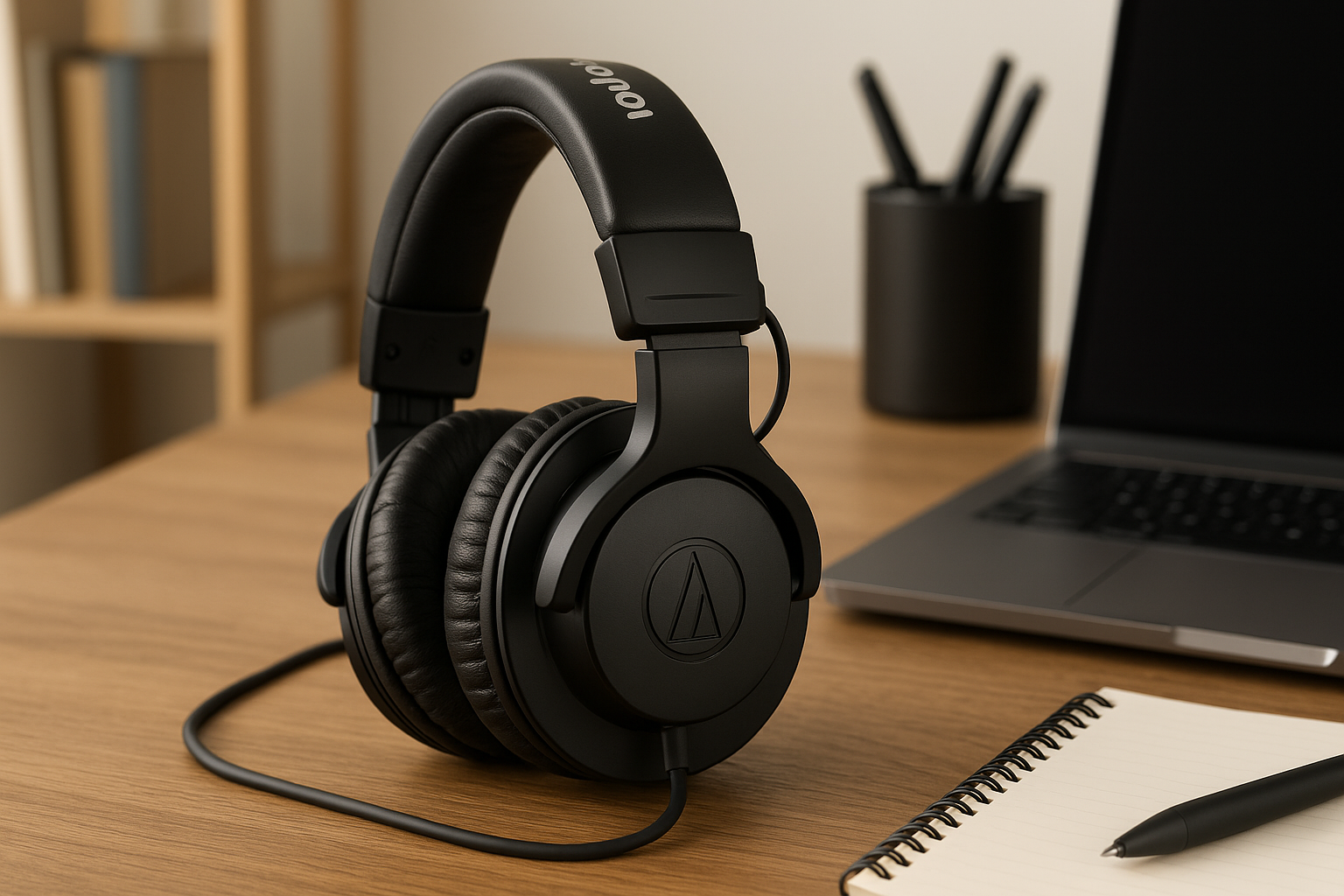
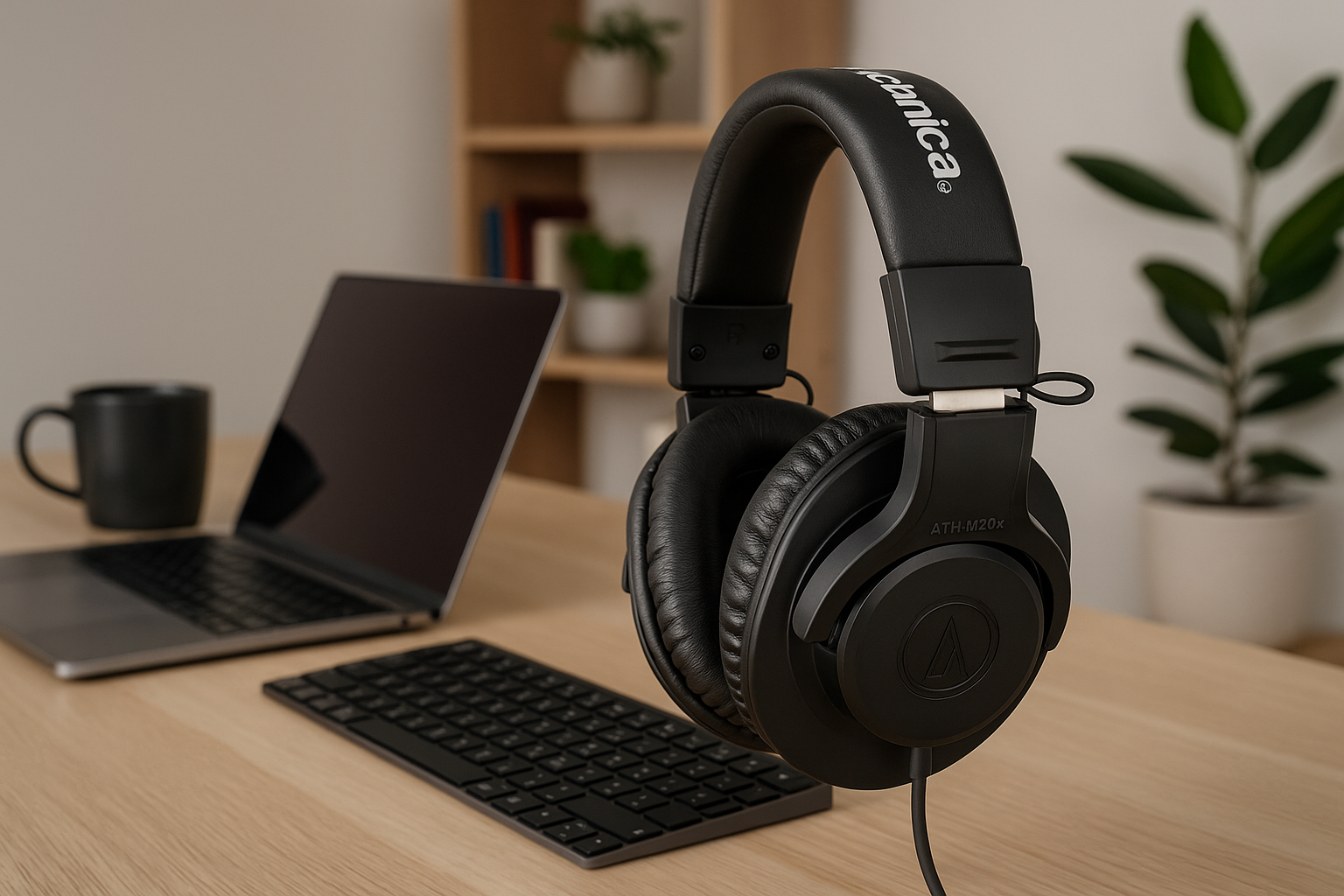
The Audio-Technica ATH-M20x is the one we keep coming back to for focus work. The tuning is neutral without being harsh, the 40mm drivers handle instrumental genres cleanly, and the closed-back isolation is sufficient for most home offices, based on owner feedback on the M-series line. It’s not audiophile-tier — the cable is fixed, the pads are basic pleather — but as a “put them on and forget about them” focus tool, it punches well above its tier.
FAQ
What’s the difference between 32 ohms and 250 ohms — and which should I get? Impedance describes how much electrical resistance the headphones present to your source. Low-impedance models (roughly 16-80 ohms) run cleanly from phones, laptops, and audio interfaces without help. High-impedance models (250+ ohms) need more voltage to hit listening volumes and can sound thin or quiet straight from a laptop. For a focus setup driven by a computer, stay in the low-impedance tier — the ATH-M20x at 47 ohms is a safe pick.
Do I need a DAC or headphone amp? For entry-level studio monitors in the 32-80 ohm range, no. Your laptop’s built-in headphone jack or a basic USB audio interface is fine. A dedicated DAC/amp becomes worthwhile if you move to 250-ohm models (e.g., Beyerdynamic DT 770 Pro 250Ω) or if your laptop’s jack has audible hiss. A USB DAC closes most of that gap.
Do budget studio headphones work with phones that removed the headphone jack? Yes, with a USB-C-to-3.5mm or Lightning-to-3.5mm adapter. Apple’s and Google’s first-party adapters include a basic DAC and drive low-impedance monitors without issue.
Can I use studio headphones for video calls? Yes, but you’ll need a separate microphone — most studio monitors don’t include one. A basic USB mic or a clip-on lav is enough. The headphones themselves work fine with any USB audio interface or direct 3.5mm jack.
How long should a pair of budget studio headphones last? Many owners report 3-5 years of daily use on entry-level models, with the ear pads being the first part to wear out. Replacement pads are inexpensive and widely available for common models like the M-series and Sony MDR-7506.
The bottom line
For focus and concentration, the headphones that sound the most exciting in a 30-second demo are usually the wrong choice for 30-hour work weeks