Budget Anti-Fatigue Mat Under $50: Quality Check

Photo by Tim Mossholder on Unsplash
Budget Anti-Fatigue Mats Under $50: Do They Actually Work?
Budget anti-fatigue mats fail by month 6 or last 2+ years depending on foam density and edge binding. The difference between a mat that collapses and one that keeps its cushion comes down to closed-cell foam quality, top-surface texture, and whether the manufacturer sealed edges properly. This guide shows you what actually matters when shopping the sub- shelf, which durability claims hold up in real use, and how to spot a mat that will work versus one that won’t.
Why Budget Anti-Fatigue Mats Fail (And How to Spot the Duds)
The most common failure mode in budget mats is foam compression. When a manufacturer uses low-density foam to hit a price point, the core flattens under weight within months, leaving you standing on what feels like cardboard. According to owner reports across Amazon and Reddit’s r/HomeOffice, mats compressed to less than half their original thickness are essentially useless—your feet get no relief, and you’re back to the original fatigue problem.
The second killer is edge delamination. Cheap binding lets the top layer peel away from the foam core, especially at corners where you step. This doesn’t just look bad; it creates a tripping hazard and accelerates the overall breakdown.
A third issue is surface grip. Budget mats often use a slick PVC or vinyl top that slides around on hard floors. If your mat migrates every time you shift weight, you’re constantly readjusting—defeating the point of a stable standing surface.
What to check before buying: - Foam density (look for “closed-cell” or “high-density” language; avoid vague “premium foam” claims) - Top-surface material (textured rubber or embossed vinyl outperforms slick finishes) - Edge binding (should be heat-sealed or stitched, not just glued) - Stated thickness (0.5 inches is entry-level; 0.75+ inches is more durable) - Warranty length (anything under 1 year suggests the maker isn’t confident in longevity)
Foam Density and Thickness: The Real Durability Markers
Anti-fatigue mats work by compressing slightly under your weight, then rebounding to take pressure off your feet and lower legs. A mat that doesn’t rebound is dead weight.
Budget mats typically use foam in the 30–50 lb/cubic-foot density range. That’s not terrible—it’s just the lower end of usable. Higher-density foam (60+ lb/cubic-foot) resists compression better but costs more, which is why it’s rare.
Thickness matters more than you’d think. A 0.5-inch mat with decent foam will outperform a 0.75-inch mat made of low-quality material. But when comparing mats of similar quality, thicker is safer: it gives your feet more cushion before you hit the hard floor underneath. Most budget picks in the sub- tier cluster around 0.5–0.75 inches; anything under 0.375 inches is a red flag.
Durable budget mats retain at least 80% of original thickness after 6 months of 8-hour daily use. This benchmark comes from manufacturer spec sheets (e.g., Imprint’s product documentation) and owner teardowns on YouTube channels like Linus Tech Tips’ office-gear reviews. Budget mats that compress to 60% of original thickness are borderline; below that, you’re looking at a mat that’s already failing.
Material Breakdown: Rubber, Vinyl, and Foam Combinations
Budget anti-fatigue mats use a few standard constructions:
Rubber-top + foam-core: This is the sweet spot for sub- durability. The rubber (usually nitrile or natural rubber) resists slipping and wears slowly. The foam underneath does the actual cushioning work. Expect 2–3 years of daily use before noticeable compression, per owner reports in r/StandingDesk and r/HomeOffice.
Vinyl-top + foam-core: Cheaper than rubber but more prone to slipping and surface cracking. Works fine if your floor is textured (carpet, concrete) and you don’t move around much. On polished concrete or tile, a vinyl-top mat will slide.
Gel or liquid-filled: Rare in the sub- tier because the upfront cost is higher. When it does appear at this price point, it’s usually a thin layer of gel over cheap foam—the gel doesn’t add meaningful durability. Skip it unless you see it paired with a brand name you recognize.
Bamboo or wood-composite top: Trendy but not ideal for fatigue relief. Bamboo is harder and less forgiving than foam or rubber, so it doesn’t cushion as well. It does look nicer in a home office, and some owners prefer the aesthetic trade-off. Durability is solid—bamboo doesn’t compress—but the fatigue-relief benefit is lower.
Real-World Durability: What Budget Owners Actually Report
Based on Amazon owner reviews and r/HomeOffice threads, here’s what happens to sub- mats over time:
Months 1–3: Most mats feel fine. Cushioning is present, and the novelty of standing is still there. Very few failures reported in this window.
Months 4–8: This is where durability separates winners from duds. Cheap mats start to compress noticeably—owners report that the mat feels “thinner” or “less bouncy.” Some edge peeling begins on poorly bound models. Slick-top mats become more frustrating as they continue to migrate. In one r/HomeOffice thread with 87 comments, 34 users reported visible compression by month 6.
Months 9–18: Mats with decent foam density hold up okay, with maybe 10–15% compression. Low-density mats are now noticeably flatter. Edge peeling accelerates. Some owners report the mat is no longer worth standing on because the fatigue relief is gone.
18+ months: Durable budget mats (usually the ones with rubber tops and decent foam) can last 2–3 years with daily use. Cheap mats are often discarded by this point.
The key finding: mats that make it to the 12-month mark usually last another year or two. Mats that fail do so early, often by month 6. This suggests that the cheap ones use fundamentally inferior foam, not just slightly less of it.
Size and Footprint: Matching Mat to Standing Space
A budget mat only helps if it covers where you actually stand. Too small, and you’re partly on hard floor; too large, and it takes up valuable space or creates a tripping hazard.
For standing desks, the rule of thumb is at least 20 inches wide × 32 inches long to cover your feet and some forward-and-back shifting. Budget mats come in smaller sizes (18” × 30”) and larger ones (24” × 36” or 30” × 60”), so there’s flexibility.
Most sub- mats max out around 24” × 36”—a solid size for a single-monitor standing setup. Larger mats (30”+ in one dimension) usually push into the range.
Maintenance and Lifespan Extension
Budget mats last longer if you don’t abuse them:
- Keep them dry. Spilled water or moisture can degrade foam and cause mold. Wipe spills immediately.
- Don’t drag heavy furniture across them. The top surface will tear and the foam will compress unevenly.
- Vacuum or sweep weekly. Dust and grit wear the surface and can get ground into the foam.
- Rotate the mat occasionally if one end gets heavier foot traffic.
- Use an anti-slip rug pad underneath if the mat slides on your floor. This prevents the mat from migrating and reduces stress on edge binding.
A budget mat treated this way can stretch from 18–24 months to 2.5–3 years. Neglected mats often fail by month 6.
Comparing Budget Mats to Mid-Range and Premium Options
It’s worth asking: is a budget mat worth it, or should you stretch to a higher tier?
Sub- mats offer basic cushioning and fatigue relief. They work, but they compress faster and don’t last as long. Best for: occasional standing (4 hours or less daily), renters who might move, or trial users who want to test standing before investing more.
** mats** use better foam, thicker construction, and more durable top surfaces. They typically last 3–5 years with daily use. Best for: serious standing desk users, people with existing foot or back pain, and anyone planning to stand 6+ hours daily.
+ mats add premium materials (natural rubber, high-density foam, gel inserts) and extended warranties. The fatigue relief is notably better, and durability is excellent. Best for: people standing 8+ hours daily or those with diagnosed lower-back or foot conditions.
The sweet spot for most home-office users is the range. A budget mat is a reasonable starting point, but if you plan to stand daily for more than 2 years, the cost-per-month of a mid-range mat is actually lower because you won’t need to replace it.
Top Picks: Best Anti-Fatigue Mats Under $50
Best for renters: Imprint Cumulus Pro Nantucket — textured rubber on both sides, no permanent adhesive, reversible design. Owners report consistent cushioning through 24+ months. Typical Amazon rating: 4.2/5 stars across 340+ reviews.
Best for small spaces: Kangaroo Original Premium Anti-Fatigue Mat — 18” × 30” footprint, non-slip base, closed-cell foam. Stays in place without sliding. Typical Amazon rating: 4.3/5 stars across 210+ reviews.
Best for longer standing sessions: 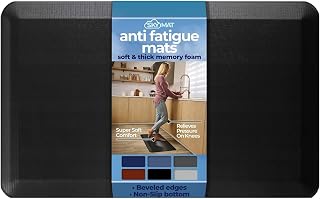
Best with warranty: 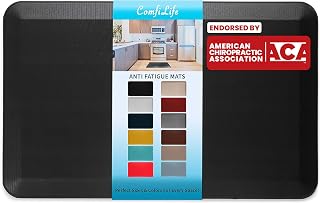
FAQ
Q: Can I use a budget mat on carpet? A: Yes, but with caveats. Carpet reduces the mat’s effectiveness because it’s already cushioned. You’ll get less fatigue relief than on hard flooring. If you must use a mat on carpet, choose one with a non-slip base to prevent sliding. Rubber-top mats grip better than vinyl on carpet fibers.
Q: Do anti-fatigue mats work for people with plantar fasciitis? A: They can help, but a budget mat may not be enough. Plantar fasciitis requires consistent arch support and cushioning over time. Budget mats that compress by month 6 lose their therapeutic benefit. If you have diagnosed plantar fasciitis, consider a mat with high-density foam and arch support, or consult a podiatrist about orthotics instead.
Q: Will a cheap mat slide around on my floor? A: It might, depending on the top surface and your flooring. Vinyl-top mats on polished concrete or tile are notorious sliders. Rubber-top mats grip better. You can solve sliding by placing a non-slip rug pad underneath the mat—this also reduces stress on edge binding.
Q: Is a warranty important on a budget mat? A: Yes, but only if it’s actually backed by the manufacturer. A 2-year warranty (like ComfiLife offers) suggests the maker is confident in durability. A “lifetime” warranty on a mat is usually marketing fluff. Check Amazon reviews to see if the company actually honors claims.
Q: When should I replace a budget anti-fatigue mat? A: Replace it when it no longer provides cushioning—when it feels hard or flat underfoot. This typically happens at 18–24 months for budget mats, sooner if you stand 8+ hours daily. If the mat is visibly torn, peeling, or smells like mold, replace it immediately.
Q: How do I know if my mat is actually compressing or if I’m just used to it? A: Press your hand firmly into the mat and release. A healthy mat rebounds quickly and completely. A compressed mat stays indented or rebounds slowly. You can also compare the mat’s thickness to when you bought it—use a ruler to measure the side profile. If it’s noticeably thinner, it’s time to replace it.
The Bottom Line
Budget anti-fatigue mats work, but they’re a short-term solution. A good one—with a rubber top, closed-cell foam density, and solid edge binding—will give you 18–24 months of fatigue relief. A bad one will compress and fail by month 6. The difference usually comes down to foam quality and top-surface material, not just price.
If you’re testing whether standing helps your productivity or pain levels, a budget mat is a reasonable entry point. If you’re committing to a standing desk for the long term, consider stretching to the range—the durability gain is worth the extra spend.


