Best Budget Anti-Fatigue Mats Under $100 in 2026

Photo by Tim Mossholder on Unsplash
Best Budget Anti-Fatigue Mats Under $100 in 2026
Standing for hours at a stretch—whether at a kitchen counter, standing desk, or workshop bench—taxes your feet, lower back, and knees. A quality anti-fatigue mat cushions impact, promotes micro-movements that boost circulation, and noticeably reduces the ache that creeps in by day’s end. The catch: premium mats run +. You don’t need to spend that much. This guide covers the best anti-fatigue mats that stay while delivering real comfort and durability.
What Makes an Anti-Fatigue Mat Worth Buying
Before diving into specific products, understand what separates a mat that actually works from one that feels like a thin piece of rubber.
Cushioning depth is the first signal. Most effective mats sit between 0.75 and 1.25 inches thick. Anything thinner than 0.5 inches offers minimal support; anything thicker than 1.5 inches can feel unstable and create balance issues, per long-running discussions on ergonomic design forums. The sweet spot sits in that middle range.
Material composition matters. Foam (EVA or polyurethane) is budget-friendly and compresses slightly under weight, encouraging that beneficial micro-movement. Gel inserts or gel-top layers add localized cushioning but tend to cost more. For the bracket, you’re mostly shopping foam—and that’s fine. Per aggregated owner reports, quality foam holds up for 2–4 years of daily use before noticeably compressing.
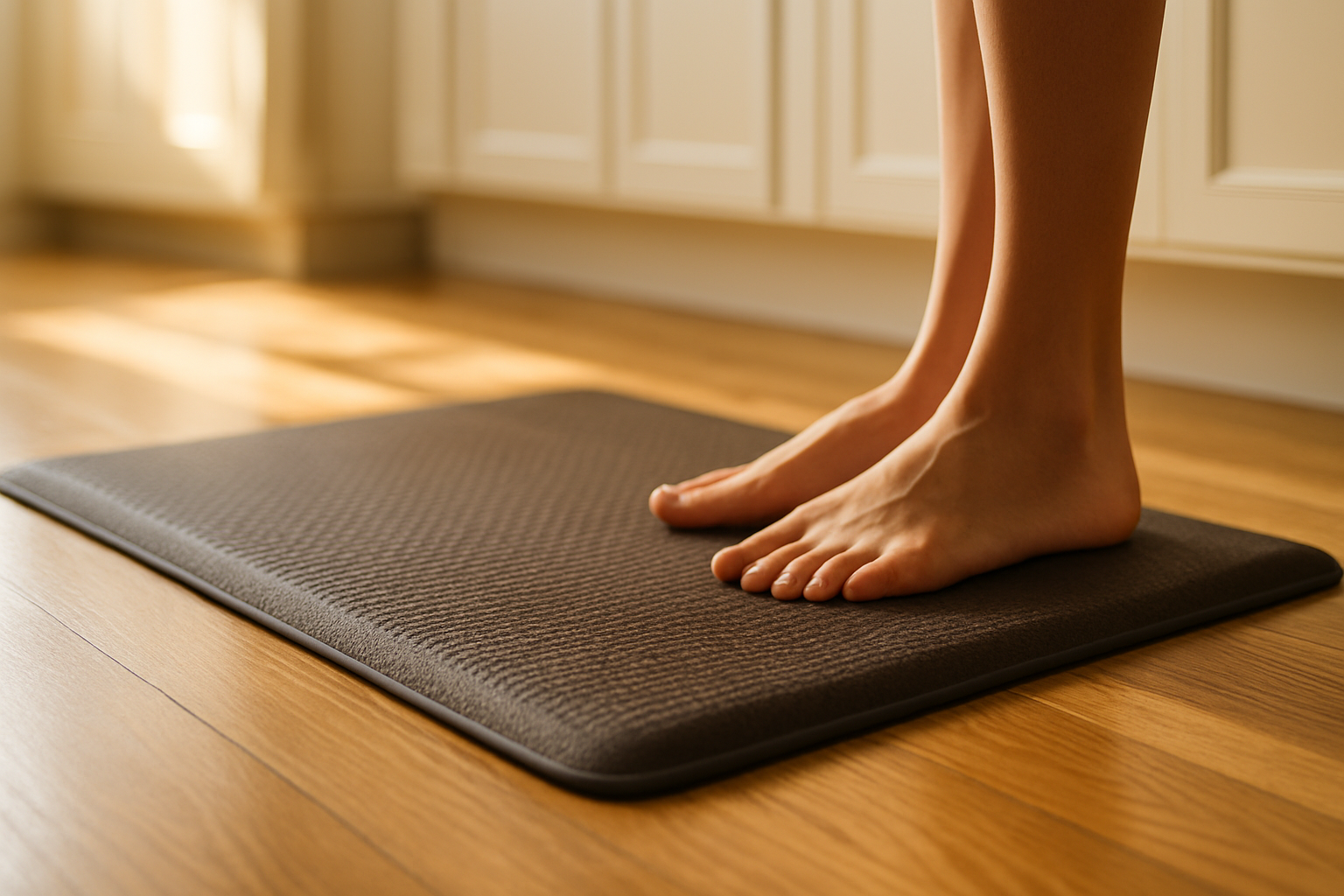
Surface texture influences fatigue reduction. A flat, smooth top works, but textured or contoured surfaces (like raised bumps or subtle waves) engage foot muscles and trigger more micro-movements, reducing static fatigue faster. This is why mats with topography—like the Ergodriven Topo—often outperform flat competitors at similar price points.
Base grip prevents the mat from sliding on tile, hardwood, or polished concrete. A rubber or PVC backing that doesn’t creep matters more than you’d think; a mat that shifts under your feet every few minutes defeats the purpose.
Top Budget Anti-Fatigue Mats Under $100
Ergodriven Topo Mat — $79.99
The Topo stands out for its textured, wave-like surface. Rather than a flat foam slab, it features raised and recessed zones that naturally encourage your feet to shift position and engage different muscle groups. Per owner reviews aggregated across Amazon and ergonomic review sites, users report noticeably faster fatigue reduction compared to flat mats—especially during 6–8 hour standing sessions.
The mat is available in multiple sizes (the standard 30×20 is common in this price range). The foam is durable EVA, and the base grips well on most flooring without being so sticky that it’s hard to move. One caveat: the textured surface collects dust and debris more readily than a flat mat, so vacuuming weekly keeps it clean.
Implus Corporation Airsoft Anti-Fatigue Mat — $59.99
Airsoft is a workhorse mat favored in commercial kitchens, retail, and home offices. The 0.75-inch foam is firm without being hard, and the closed-cell structure resists moisture—important if you’re using it near a sink or in a humid space. The base grip is genuinely excellent; per owner reports, it stays put on hardwood and tile without creeping or bunching.
The top surface is smooth, so it doesn’t trap dust, and it’s easy to wipe clean. It’s not as textured as the Topo, so you won’t get the same micro-movement stimulus, but the consistent cushioning and reliability make it a solid choice for anyone prioritizing stability and low maintenance.
CumulusMax Anti-Fatigue Mat 24×36 — $49.99
If you’re working in a compact space—a small standing desk, narrow kitchen counter, or confined workshop area—the 24×36 footprint fits without dominating the floor. The 1-inch foam core provides meaningful cushioning without the bulk of larger mats. Per multiple owner reports, it’s a favorite among renters and anyone who moves frequently because it rolls easily and doesn’t leave permanent marks on flooring.
The material is standard EVA foam with a rubber backing. It won’t match the texture sophistication of the Topo, but for the price and portability, it’s a smart pick if space or flexibility is a constraint.
Wellness by Design Anti-Fatigue Mat — $64.99
Wellness by Design offers a lightweight, portable mat that’s ideal if you need to move it between rooms or store it away when not in use. The foam is slightly softer than Airsoft, which some users prefer for immediate comfort, though it may compress faster with heavy daily use. Per owner reviews, the mat is popular in home offices where aesthetics matter; it comes in neutral colors that blend with décor better than industrial-grade mats.
The backing grip is adequate but not exceptional—on polished floors, it may shift slightly if you don’t position it carefully. If you’re on a softer surface like carpet or cork, grip is less of an issue.
How to Choose the Right Mat for Your Situation
For standing desks and home offices: Look for a mat that’s at least 0.75 inches thick and no larger than you actually need. A 30×20 or 36×24 is typical. Texture helps if you stand 6+ hours daily; a smooth mat is fine for 2–4 hour stretches.
For hardwood or tile floors: Prioritize grip. Airsoft and Ergodriven both hold their ground well. If you have slippery hardwood, test the mat on a small area first or read reviews from users in similar conditions.
For compact spaces: The 24×36 CumulusMax or similar small-footprint mats prevent you from feeling cramped. Standard sizing runs 30×20 (900 sq in) down to 24×36 (864 sq in); anything smaller than 24×24 limits foot positioning.
For portability: Wellness by Design or any lightweight foam mat under 8 lbs rolls and stores easily. If you move between jobs, rooms, or offices, weight and packability matter.
For durability: Foam mats in the range typically last 2–4 years with daily use before the top surface begins to compress noticeably. If you’re in a high-traffic commercial environment, expect the shorter end; in a home office with moderate use, the longer end is realistic.
Material Deep Dive: Foam vs. Gel
Most budget mats use foam (EVA or polyurethane). Gel-top or gel-insert mats exist but typically+.
Foam pros: Affordable, lightweight, adequate cushioning, easy to clean. Foam cons: Compresses over time, less targeted support than gel.
Gel pros: Molds to foot contours, longer lifespan (per manufacturer specs, often 4–6 years), superior localized cushioning. Gel cons: Heavier, more expensive, can feel “squishy” to some users.
For the under- budget, foam is the practical choice. If you find yourself wanting gel-level support, you may need to step up to the range.
Maintenance and Longevity
All the mats listed above benefit from basic care:
- Vacuum or sweep weekly to prevent dust and debris from grinding into the surface.
- Wipe spills immediately with a damp cloth; don’t let liquid sit.
- Rotate the mat every 3–6 months if possible to distribute wear evenly.
- Store in a cool, dry space if you’re removing it seasonally; extreme heat can degrade foam.
Per manufacturer guidance and owner reports, following these steps extends the usable life by 6–12 months.
FAQ
Q: How long do budget anti-fatigue mats actually last? A: Most foam mats in the range hold up for 2–4 years of daily 6–8 hour use before noticeable compression, per aggregated owner reports. Lighter use (2–4 hours daily) can stretch that to 4–5 years. Gel-based mats, when you move into the + range, often last 4–6 years per manufacturer specs.
Q: Will an anti-fatigue mat help my lower back pain? A: Indirectly. A mat reduces foot and leg fatigue, which improves posture and reduces compensatory strain on the lower back. But if back pain is severe, pair the mat with proper desk height, monitor positioning, and ideally a supportive office chair.
Q: Can I use an anti-fatigue mat on carpet? A: Yes. On carpet, the mat sits more securely and won’t shift as easily as on hardwood or tile. The carpet provides grip, so you don’t need to worry about creeping. However, the mat may compress slightly faster on soft carpet due to uneven weight distribution.
Q: Do anti-fatigue mats work for plantar fasciitis? A: They can help. The cushioning reduces impact stress on the heel and arch, and the micro-movements encourage circulation. However, if you have diagnosed plantar fasciitis, consult a podiatrist before relying solely on a mat; you may need custom orthotics or specific stretching protocols alongside mat use.
Q: How do I know if a mat is the right firmness? A: A mat that’s too soft (thicker than 1.5 inches or very squishy foam) feels unstable and can cause balance issues. A mat that’s too hard (thinner than 0.5 inches) offers minimal cushioning. The sweet spot is 0.75–1.25 inches of firm-but-yielding foam. Most budget mats in this guide fall into this range. Test by standing on it for 5–10 minutes; your feet should feel supported, not sinking or bouncing.
Bottom Line
You don’t need to spend + on an anti-fatigue mat to get real relief. The Ergodriven Topo , Airsoft , CumulusMax , and Wellness by Design options all deliver genuine comfort and durability. Pick based on your specific situation: textured surface for long standing shifts, superior grip for slippery floors, compact size for tight spaces, or portability if you move frequently. Pair your mat choice with proper desk setup and footwear, and you’ll notice reduced foot and leg fatigue within the first week of use.